[00:00:00] Mark Milliron: My competitors aren't institutions. My competition's poverty. Mm-hmm. Like, we're trying to open the doors to opportunity for these students. How can we leverage AI to make sure that every employee and, and, and by [00:00:10] extension, every student, actually has an AI, a set of AI tools, agents, resources, that can make their life better and can actually make their job, uh, more efficient, more effective, [00:00:20] like, really help them in this process?
[00:00:21] Mark Milliron: How do you work with these resources to be able to do it? What's kind of great now is it's an amplification. 'Cause in addition to having the AI agents [00:00:30] or grad students, you can now have grad students plus AI. Being a working student or a parent or this or that, it does not work in the traditional model.
[00:00:37] Mark Milliron: So for them, if we can find and help them [00:00:40] navigate the higher education pathway with a different learning model, different support structures, different value propositions, great things can happen. What I hope people see about National University is that [00:00:50] we are, we're, we're in that family of learners who, like, the main thing is the main thing, which is to help those students be more successful.
[00:00:57] Mark Milliron: It's not about our brand, it's about our, it's about our work. [00:01:00]
[00:01:00] Rubén: Happy Thursday. My name's Rubén Harris, and this is The New Normal. The New Normal is a show where we go inside of organizations that are actually using AI in production at [00:01:10] scale in a way that's making a meaningful impact in their organizations.
[00:01:13] Rubén: It's not a show about hype. It's a show where we interview leaders who have made decisions to reimagine their organizations [00:01:20] with AI at its core Today we're in San Diego. This morning at 5:45 AM, I took a five-mile hike down La Jolla [00:01:30] at the suggestion of our guest that I'm very excited to introduce you to.
[00:01:34] Rubén: We're on the campus for National University, and I'm here with the president, Mark [00:01:40] Milliron. So welcome, Mark.
[00:01:41] Mark Milliron: Glad to be here. I'm glad you got on that hike. It's a beautiful scene, right?
[00:01:44] Rubén: It was very, very nice. Um, I'm very excited about this conversation- Good ... because we had dinner last [00:01:50] night, and you shared so many frameworks that I think are gonna be helpful for people that are listening today.
[00:01:55] Rubén: But I wanna start off by talking about your resume. Your background is one of the most- ... [00:02:00] unique backgrounds. It's not just private sector, higher ed, foundations. What... Tell, tell us a little bit about your background.
[00:02:05] Mark Milliron: Uh, I have had the great pleasure of working in a lot of different sectors. [00:02:10] Uh, and if, as you actually look at my background, it's been everything from being a teacher in higher education to being a leader in higher education to working to advance education in the corporate side, especially with [00:02:20] information technology.
[00:02:21] Mark Milliron: I've been able to work in the foundation world. Been able to work in even with the state department inter- internationally. But the red thread in all of my [00:02:30] positions has been this kind of personal commitment to help more and more diverse students be more successful in education pathways. I, I... And I, and I'll just quickly go back.
[00:02:39] Mark Milliron: I c- come [00:02:40] from a family of nine kids. I have an African- Awesome ... American brother, a Native American brother, Korean sister. 25 foster kids rotated through my house during the time I was growing up. Wow. And we had no knowing about higher [00:02:50] education and what that pathway would look like. And if it wasn't for a community college, Mesa Community College in, in Arizona, absolutely was my kinda doorway, my, my [00:03:00] pathway to possibility, if you will.
[00:03:01] Mark Milliron: So I bused tables, waited tables, paid my way through school, got through Mesa, transferred to Arizona State, got two degrees at ASU, doctorate at UT Austin. [00:03:10] And, um, what was pretty clear to me was access institutions with a lot of dedicated people who really cared about folks like me, um, absolutely made my pathway to [00:03:20] possibility, um, a, a reality.
[00:03:22] Mark Milliron: And I was committed to helping, how do you open that pathway for more people? And that really has been the innovation of American education over the last 150 years, [00:03:30] is how do you help more and more diverse people be more successful than ever before on that pathway? So for me, it's how do you use technology, how do you use policy, how do you use innovation, how do you use [00:03:40] different strategies within their institutions to help those students learn more, finish strong, and launch like rock stars into their careers.
[00:03:46] Rubén: Wow. Uh, you didn't share that last night, but- Yeah ... that makes [00:03:50] a lot more sense about why you're passionate about this work. Yeah. So for the people that don't know about National University- What's your scale? Like, w- how, I know you guys serve hundreds of [00:04:00] thousands of learners, so tell us how the system works and- Yeah
[00:04:02] Rubén: how you guys are connected, yeah.
[00:04:03] Mark Milliron: So National University, founded 55 years ago by a former Navy captain, uh, got his PhD, [00:04:10] became a higher education professor. Um, and he was, back in 1971, kind of heartbroken watching service members coming out of Vietnam trying to use their GI [00:04:20] Bill and access education through traditional models, and they were being savaged.
[00:04:24] Mark Milliron: And, and they were being savaged not because those institutions didn't care about them, but, but because they weren't built for them. Mm-hmm. [00:04:30] And he said, "There's gotta be a better way for working students, non-traditional students, military students to have both access and excellence on that kind of pathway."
[00:04:38] Mark Milliron: So that was the vision for [00:04:40] National, was can we create a model of education where the learning is designed for this kind of student, four-week classes, eight-week classes, um, one-to-one graduate models, and is-- can the support [00:04:50] systems be focused on this, and can the value proposition? And, and that's where he began innovating around that.
[00:04:55] Mark Milliron: And from that kind of crazy idea 55 years ago to today, we serve about [00:05:00] 130,000 learners a year. About 50,000 are in degree programs. Another, um, 80,000 are in workforce training, uh, contract training. Heavy pr- the workforce training, we have our [00:05:10] biggest and, without a doubt, our most prominent program is our Sanford Harmony Program, which is a huge relationship skills program for kiddos.
[00:05:17] Mark Milliron: Um, works with teachers, works with Boys & Girls Clubs, work with [00:05:20] school districts, um, all around the country and around the world. That program, if you wanna look up Sanford Harmony, you'll be blown away. It is, is probably connected to more than 45 million [00:05:30] kids all over the world. Wow. It's absolutely amazing.
[00:05:32] Mark Milliron: Our core degree programs, we have about 150 degree programs. About two-thirds of our students are graduate students. Um, thriving doctoral [00:05:40] programs, law school, um, you know, PsyDs, PhDs across the board. Um, and then, uh, our undergrad population is heavily dominated by military still. Okay. [00:05:50] Ha- half of our undergrad population is active duty, veteran, spouse, dependent.
[00:05:54] Mark Milliron: Um, we are, um, almost all of our students are working students. Mm-hmm. Half of our students are parents. [00:06:00] We are, um... average age of our undergrad is 32, master's 37- Wow ... doctorate's 42. Um, we are, we call our students anders. Mm-hmm. We talked about this last night. Yeah. We call them anders [00:06:10] because in traditional education, the student's primary identity is as a student.
[00:06:15] Mark Milliron: They would tell you that they are a student if you asked them who they are and what they're doing. Our students are [00:06:20] anders. They are students and parents, they are students and employee, they're students and deployed. And as we talked about last night, if you ask them to choose between their ands, you're gonna lose.
[00:06:28] Mark Milliron: Mm-hmm. Because that parent thing's a big [00:06:30] deal to them, that work thing's a big deal to them. Mm-hmm. And so we design for that student population. That is 100% of our student population. It is a feature, not a bug. It is [00:06:40] exactly who we've always served, and our faculty are committed to it, our support staffs are committed to it, our, um, outreach strategies are all focused on it.
[00:06:47] Mark Milliron: So National's a different kind of [00:06:50] institution. We understand who we are. Mm-hmm. If you're an 18-year-old who wants a campus-based experience, for the love of God, don't come to National. Like, there are other great places you can go. There really are phenomenal [00:07:00] places. Mm-hmm. But later in life if you need flexibility and you wanna rise and thrive and get that MBA or get that doctorate degree while you're working, guess what?
[00:07:07] Mark Milliron: That's us.
[00:07:07] Rubén: Awesome.
[00:07:08] Mark Milliron: Yeah, so it's, that's us in a nutshell.
[00:07:09] Rubén: [00:07:10] Yeah. No, I wanna talk about anders in a second, and I wanna frame it in something else that you shared last night. So, um- Obviously, I'm in the tech sector. Before that, I was in finance. [00:07:20] Um, there's a lot of competition in the world, right? Yeah. And you said something about competition that I think is very special.
[00:07:29] Rubén: So [00:07:30] what, what, what is your competition? Like e- even with, with, with people, they're applying to different schools. Yeah. They're, they're, they're trying to choose where they wanna go. Schools might be competing with each other for a student. [00:07:40] How do you think about competition? Yeah.
[00:07:41] Mark Milliron: So two things super important in our work in the world of education.
[00:07:45] Mark Milliron: Um, one is having worked at major associations like the League for [00:07:50] Innovation or foundations like the Bill & Melinda Gates Foundation, um, and I chair the board for the Trellis Foundation- Mm-hmm ... and still work with Trellis now. Um, one of the things you learn pretty quickly is that [00:08:00] one of the neat features of higher education is that there's this meta feature, which I've jokingly called it the CASE method, and CASE stands for copy and steal everything.
[00:08:08] Mark Milliron: Like what I mean by that is [00:08:10] like the really good people, they're scouting. Mm-hmm. They're constantly looking for good ideas, and higher education shares. Mm-hmm. I mean, they will work with each other like crazy. And so it... What that basically [00:08:20] means is if you're doing it really well, because of the desperate need that's out there, um, uh, I- when people say, you know, if you're in the software industry- Mm-hmm
[00:08:27] Mark Milliron: like you get this, people say, "Oh, if your [00:08:30] investors would immediately say who are your top competitors, you'd have to name your top competitors- Mm-hmm ... and talk about X, Y, and Z." My top competitors aren't, I always say my competitors aren't institutions. My comp- my competition's poverty. Mm-hmm. [00:08:40] Like we're trying to open the doors to opportunity for these students and figuring out how we can make more of that.
[00:08:45] Mark Milliron: What's great is I've got partners in common cause. Mm-hmm. We're a part of the Presidents' Forum, which is this kind of big [00:08:50] advocacy- Wow ... organization of like-minded institutions. So whether it's, um, Scott Pulsipher at Western Governors- Mm-hmm ... Greg Fowler, who I love over at UMGC, or if, or if it's Madeline Dowd [00:09:00] at, at, at Miami Dade- Mm-hmm
[00:09:01] Mark Milliron: we are all about like trying to help open these pathways to possibilities for this kind of student population, and we share ideas all the time- Yeah ... in that kind of [00:09:10] larger work. And- That, that, you know, the other thing related to that, e- even though I've been able to learn from every sector I've been able to be a part of, whether it's foundation world, [00:09:20] business world, policy world, um, one of the things I, I draw from the analogy, but you wanna make sure it's, it's contextually appropriate.
[00:09:27] Mark Milliron: So I, I'm not a huge fan of the business [00:09:30] metaphor in education. Mm-hmm. We talked about this- Yeah, yeah ... last night, and this AI actually fits in here because people- Yeah ... will jump to AI because it's a business tool. Mm-hmm. But AI is not just a business tool. Mm-hmm. [00:09:40] AI is a universal- Mm-hmm ... infrastructure that people who are a mission-driven organization, businesses, civic organizations- Mm-hmm
[00:09:47] Mark Milliron: like AI can be used by anybody and everybody, [00:09:50] very similar to how the internet kind of- Yeah ... like came to be. So we have to be careful not to jump to, oh, we have to use business principles. Mm-hmm. And one of the reasons I say that is, like most businesses fail.
[00:09:58] Rubén: Yeah.
[00:09:59] Mark Milliron: Yeah. So, [00:10:00] and, and like I would argue it's about what is, what is your mission?
[00:10:04] Mark Milliron: What is your vision? What are the kind of things you're trying to achieve? And can these tools, these technologies, these [00:10:10] policies, these practices help you achieve those things? So it's not about running like a business, it's like running like a great university and making sure you are, um, adopting those policies, [00:10:20] practices.
[00:10:20] Mark Milliron: And, and, and of course, finance matters. It has- Mm-hmm ... to be deeply sustainable. There's no doubt. Yeah. But I'm really focused on the student learning outcomes. Are students learning well, finishing strong, kind of launching effectively? And [00:10:30] can we do that in a sustainable way? If you qu- oh, quote, unquote, "operate like a business," people get hyper-focused on the finance, and when they do that, they end up like pulling [00:10:40] levers.
[00:10:40] Mark Milliron: Like you might scale too quickly. You gotta, you know, we always focus on we don't wanna be a big university. Mm-hmm. We're big whether we like it or not, because- Mm-hmm ... people love our model, and they wanna jump into it. [00:10:50] That's not the goal. Mm-hmm. Our goal is not to be a mega university at all. Mm-hmm. Our goal is to be a great university.
[00:10:55] Mark Milliron: Mm-hmm. We want our students to learn well. So AI, we're gonna put AI on purpose. Mm-hmm. [00:11:00] Right? So the worst thing in the world to do with AI is, "We're going to do AI." Mm-hmm. Well, why? Yeah. Like you gotta have a why. Yeah. And, and for us, we're gonna put it on purpose. And for us- Yeah ... it's how do we help our students learn more [00:11:10] effectively?
[00:11:10] Mark Milliron: How do we support them more effectively? How do we help our employees do their jobs more effectively and in really kind of a, a really clear way? And how do we achieve that mission-
[00:11:18] Rubén: Yeah ...
[00:11:18] Mark Milliron: at a higher level? That's [00:11:20] the conversation we have with our board.
[00:11:21] Rubén: Yeah. And I, I love the, you've, you've already shared a few analogies with the Anders and, and everything like that.
[00:11:27] Rubén: And, and I like the focus on [00:11:30] collaboration and sharing ideas. Uh, and you brought up AI, so- Yeah ... let's talk about AI now Another term that you use is wingman. Yeah. [00:11:40] Can you talk about wingman and how you think about it for your staff and how you think about it for learners?
[00:11:45] Mark Milliron: Yeah. So, um, obviously with our military connection, wingman makes all the sense in [00:11:50] the world.
[00:11:50] Mark Milliron: Our mascot's a peregrine falcon. You might see one of them fly by. Yeah. They actually nest out here by our office. Um, and, and our, and our hand symbol, like, you have to have your hand symbol is wings up. Wings up, yeah. It's not [00:12:00] shaka. It's not hang loose. It is wings up, and we always say, "You can't soar unless your wings are up."
[00:12:04] Mark Milliron: Mm-hmm. Um, one of the things we thought of immediately with AI was how can we leverage AI to make [00:12:10] sure that every employee and, and, and by extension every student actually has an AI, a set of AI tools, agents, resources that can make their life better and can actually make their [00:12:20] job, like, more efficient, more effective, like really help them in this process?
[00:12:23] Mark Milliron: And at our best, like, our aspiration is every employee, every student actually has a wingman that can help them do this work. So we started [00:12:30] rolling out the wingman initiative, um, over the course of the last year, and it's been wildly successful. Mm-hmm. And let, let me just give you a basic idea of, like, why this is so important.
[00:12:39] Mark Milliron: [00:12:40] Um, when I was at the Bill & Melinda Gates Foundation, one of the most eye-opening parts of our work was when we really discovered the fact that, um, you know, the majority of [00:12:50] low-income first-generation students fail on higher education pathways. Mm-hmm. Working students have serious problems and, and the majority of them leave in good academic standing.
[00:12:58] Mark Milliron: They leave because life happened, [00:13:00] psychosocial things happened, and often because their life doesn't fit with the traditional model in terms of how it plays in. And what we learned was is people are hyper-focused on the [00:13:10] academic issues. Mm-hmm. They were trying to fix the curriculum. They were trying to fix the way we taught math.
[00:13:13] Mark Milliron: Mm-hmm. They were trying to fix this. All really important things, but actually what you needed to focus on was navigation. [00:13:20] Mm-hmm. How do you help those students navigate the process and, and balance it with their lives in some ways? That was super eye-opening. Yeah. And folks like the University Innovation Alliance- Mm-hmm
[00:13:28] Mark Milliron: folks like Achieving the Dream have [00:13:30] all been kind of doubling down in the last decade on how you kind of focus on navigation. It's the heart of the Pathways movement, right? Yeah. So one of the things that we really realized was you [00:13:40] wanna make sure that you can help your students make the most of their time with us.
[00:13:44] Rubén: Mm-hmm. You know, we were, we were talking about it last night. I think analytics at their worst, AI at the, at their worst, is focused [00:13:50] on mitigating risk.
[00:13:51] Rubén: Yeah.
[00:13:51] Mark Milliron: Your math models are all screwed up if all you care about is reducing risk. What we wanna do is optimize outcomes. We want our students to literally suck the marrow out of this [00:14:00] experience.
[00:14:00] Mark Milliron: Mm-hmm. How do they get every possible piece of goodness out of this, meet the right people, have the right experiences, co-curricular processes along the way? College is not a collection [00:14:10] of classes. It's a family of experiences that you curate together to help them change their lives, right? Yeah. So for us- The idea would be how do we help those students kind of navigate and [00:14:20] how do we make sure we're aware of all what would be possible for that student?
[00:14:23] Mark Milliron: So what we do is in our, uh, I'll just give you an example of like the eye-opening part of this. We actually have a program called [00:14:30] NULA, which is our National University Leadership Academy. Uh, we do 25 rising leaders every year, a 12-module curriculum. But one of the exercises we do in that is we literally [00:14:40] have them look at Uh, okay, here's type one, type two, type three reasons people leave.
[00:14:45] Mark Milliron: Mm-hmm. It's, it's life and logistics- Yeah ... psychosocial, academic. Yeah. What [00:14:50] are the things we have at NU that will help? So we take these, these 25 leaders, we break them into groups. We want you to just brain dump every resource we have at NU that can help somebody [00:15:00] with an academic issue, a psychosocial issue, or a life and logistics issue.
[00:15:04] Mark Milliron: Tutoring center, outreach, this, that, whatever it is. And we end up with these, every group ends up with these [00:15:10] scrolling lists- Mm-hmm ... of these amazing resources we have at NU, and everybody's just oohing and aahing. And, uh, when we look at this group of people who are, some new, some are two or three years in, others are 30-year [00:15:20] vets- Mm-hmm
[00:15:20] Mark Milliron: and it's, um, "Okay, how many of you learned about a new thing we were do- we- we've, you know, to- learned about a new thing today that you didn't know that we were offering to our students?" Mm-hmm. Every, every [00:15:30] hand goes up.
[00:15:30] Rubén: Wow.
[00:15:30] Mark Milliron: Everybody's learned something different.
[00:15:32] Rubén: Yeah.
[00:15:32] Mark Milliron: And I'm like, "You work here."
[00:15:34] Rubén: Mm-hmm.
[00:15:34] Mark Milliron: Like, imagine if you're a student trying to navigate this process- Mm-hmm
[00:15:38] Mark Milliron: and you had no idea there was a [00:15:40] veteran's center resource for this. Mm-hmm. There was a library resource for this. Mm-hmm. There was a, you know, a single parent support group for X- Yeah ... Y, and Z. The wingman, what's kind of great about it as an [00:15:50] AI partner is no matter who you are, if you're a faculty member, if you're an advisor, if you're an enrollment counselor, that wingman will say, "Okay, this student in this context, oh, by the way, you might wanna think about this, this, [00:16:00] and this."
[00:16:00] Mark Milliron: Mm-hmm. And so the idea is you can optimize their experience by getting the right resource for them. Mm-hmm. And there's no single individual that can learn about every possible- Yeah ... like, resource that we have. But we [00:16:10] can actually pull that up. By the way, doctors have been doing this now with diagnostics.
[00:16:13] Mark Milliron: Mm-hmm. Having that kind of wingman in the medical industry, like w- in the medical world, is like the idea that they have all the possible [00:16:20] derivations of, of different kinds of- Mm-hmm ... um, diagnoses that they can think about as they're rolling it through. So they might not have thought about X, Y, and Z and connecting the variables.
[00:16:28] Mark Milliron: So for us, that's been one of our big initiatives.
[00:16:29] Rubén: [00:16:30] Yeah. No, I, I love you brought, you brought up the, the doctor analogy 'cause my father, he's on- in charge of the oncology department- Mm-hmm ... at Emory University, but he's also a researcher. And I like it because you're [00:16:40] using this wingman analogy for what Silicon Valley calls or tech people call AI agents, right?
[00:16:47] Rubén: And you also mentioned that [00:16:50] higher ed has been using AI agents that are actually humans for a very long time. So can you talk- Yeah. You're a writer, right? So can you talk about, like, a framework for people to [00:17:00] understand what an AI agent
[00:17:01] Mark Milliron: actually is? I think it's just a matter of making, especially faculty, comfortable with the idea of leveraging AI, and one of the things I jokingly say is every graduate professor in America should be [00:17:10] completely comfortable using AI.
[00:17:11] Mark Milliron: Mm-hmm. And part of it's because they've been using AI for hundreds of years. Mm-hmm. And what I mean by that is, is AI for them has been graduate students. Mm-hmm. They've had [00:17:20] agents all the time. Mm-hmm. They've been graduate students. Mm-hmm. So when I was coming through my graduate program, I am, uh, the first, uh, book project I was a part of, I was co-author of a big national book called Strangers In, [00:17:30] Strangers In Their Own Land, big national study of, of, uh, part-time faculty in higher education.
[00:17:34] Mark Milliron: Mm-hmm. Had the great pleasure of working with, uh, an eminent professor named Dr. John Roueche, um, at University [00:17:40] of Texas at Austin. And when, when I came with the idea of doing a project around this, he said, "Hey, we should do a book around this." Mm-hmm. And I, uh, we put together a set of grad students, and we, again, [00:17:50] conceptualized the project.
[00:17:51] Mark Milliron: He, he came in and nipped and tucked it. We did all the literature review, came back again. He and, he and his wife nipped and tucked it. And then it was like, okay, we're gonna conduct [00:18:00] the research. And we went and did all the research, but he made all the calls to a bunch of per- presidents to make sure they responded- Mm-hmm
[00:18:05] Mark Milliron: to X, Y, and Z. And then we came back and we did the analysis, and then we worked together on what the [00:18:10] framing of the messaging would be on the closing, uh, of, of the findings. It was the root of what my dissertation was, but it turned into a book before it ever was my dissertation. And the, that entire [00:18:20] experience is exactly what AI agents do.
[00:18:22] Mark Milliron: Mm-hmm, mm-hmm. It's like, and he was... And by the way, it was wonderfully beneficial for us. We learned a ton. Yeah. I learned a ton about how to, how to do that kind of [00:18:30] research and, and what you actually need to be, and what you have to be able to do to get things published. It was wonderfully valuable for me.
[00:18:36] Mark Milliron: But it absolutely was this idea of how do you work with these [00:18:40] resources to be able to do it? What's kind of great now is it's an amplification. Mm-hmm. 'Cause in addition to having the AI agents or grad students, you can now have grad students plus AI, right? There you go. And so you're kind of, [00:18:50] you're upping the game to get- Mm-hmm
[00:18:51] Mark Milliron: to collective intelligence, which we might wanna talk about later.
[00:18:54] Rubén: Yeah. Yeah,
[00:18:54] Mark Milliron: yeah.
[00:18:55] Rubén: Yeah. Um, I wanna get to that in a second. You Talking [00:19:00] about how you're touching 130,000 learners. Yeah. You have about 5,000 staff. You have gra-
[00:19:06] Mark Milliron: Faculty and staff ...
[00:19:07] Rubén: faculty and staff. You have grad [00:19:10] students that can use AI now. Um, how many of those 5,000 faculty and staff are on the phones?
[00:19:16] Rubén: And the reason why I wanna know that is there's, [00:19:20] you think about support, so it's not just about Andrews, it's about excellent and support and, and enrollment student services. So can you help us understand that?
[00:19:26] Mark Milliron: Yeah. So we're about 75/25, um, [00:19:30] online, on ground. We were about 50/50 before the pandemic, and the pandemic pushed us kind of over the edge.
[00:19:35] Mark Milliron: Um, it all base- it's all based on the kind of programs we have. If you're a nurse, guess what? You're gonna be, a lot of it's on [00:19:40] hands-on kind of larger work. Um, but on top of our, our o- online and on ground kind of mix, we also have about 5,000 clinical sites, whether it's school [00:19:50] districts, um, businesses with our cybersecurity, mental health clinics with our psy- with our, um, psychology and, and, and PsyD programs.
[00:19:57] Mark Milliron: Um, so we have, we have all these kind of learning [00:20:00] interactions happening, and they're, um, obviously in- stitched together by our combination of face-to-face and digital infrastructure. Yeah. So it's not necessarily on the phones- Mm-hmm ... as it as I would call it on [00:20:10] digital. Yeah. So they, and, and they're on digital in a way where...
[00:20:13] Mark Milliron: And by the way, we capture everything we can capture around the digital piece. Mm-hmm. We use Qualtrics and capture all the phone stuff and, and [00:20:20] one of the things we've really worked hard at is developing a comprehensive enterprise data warehouse so we can- Mm ... pull the data together. 'Cause I really feel strongly about this.
[00:20:28] Mark Milliron: I, I, you know, [00:20:30] students' data- Mm-hmm ... are used all the time.
[00:20:33] Rubén: Mm-hmm.
[00:20:33] Mark Milliron: But typically the data are used for the institution to prove- Yeah ... its worth to a, to, you know, uh, [00:20:40] to accreditors and to the federal government and whoever else it is. It's, the institution gets to use the data. Mm-hmm. I think we should be using student data to help that student.
[00:20:48] Mark Milliron: Like how do you help them make a better [00:20:50] chose- choice, go in a better direction? Mm-hmm. And that's, uh, uh, incumbent upon us to collect that data in as close to real time as possible, and then process it and analyze it and figure out how we can help them make [00:21:00] better choices, go in better directions. And that's kind of the top aspiration.
[00:21:03] Mark Milliron: But to do that, you have to do plumbing. Mm-hmm. And that plumbing is how do you... Again, you have to create your data definitions, you have to create the [00:21:10] kind of data warehouse, you have to be able to map the data, pull it together. So we've done a lot of work in the last two, three years to get that plumbing together.
[00:21:16] Mark Milliron: Yeah. And in fact, we're in the process of implementing a whole new ERP [00:21:20] system- Mm-hmm ... uh, SIS, integrating our LMS- Mm-hmm ... you know, integrating that with Salesforce. Um, and then, you know, again, ma- mapping it with Qualtrics and the rep, so that we can take that digital [00:21:30] interaction and have the equivalent of, if I'm at, if I'm at Grinnell with a 15-person class in the middle of Iowa having a deep interpersonal connection, which is [00:21:40] powerful and rich, I'm thrilled that they have that opportunity.
[00:21:43] Mark Milliron: But the, the beauty of that is that faculty member picks up all these meta signals from the student. They pick up the [00:21:50] quantitative data from whatever they're writing, qualitative from what they're writing, quantitative from what they're testing. Mm-hmm. But I'm watching your non-verbals. Mm-hmm. I'm watching your paralinguists- Mm-hmm
[00:21:56] Mark Milliron: paralinguistics. I'm picking up all these [00:22:00] signals, and my signal processing is usually, for that faculty member, happening in the brain. Yeah. And based on those signals, I'm gonna respond and I'm gonna create a more personalized experience for you. Mm-hmm. For us, it's the idea is, [00:22:10] can we take all these data that we're getting and do something deeply responsible with it- Mm-hmm
[00:22:14] Mark Milliron: which is process it and analyze it in such a way where we can help that student- Yeah ... make a better choice, go in a better [00:22:20] direction. What I don't want is for the only people to have personalized education are the people who have a half a billion, uh, sorry, half a million dollars to be able to get a degree.
[00:22:28] Mark Milliron: Yeah.
[00:22:28] Rubén: Yeah.
[00:22:28] Mark Milliron: Right? You know, that's... And, [00:22:30] and, and to me, we've gotta figure out a way how we can make that kind of personalization and optimization. Like, and we talk about the idea of Anders and excellence. Mm-hmm. We want Ander students to have the most [00:22:40] excellent. We, we do not think you have to make a choice between access and excellence.
[00:22:43] Mark Milliron: Yeah. You can do both of them. Michael Crow at ASU has been all over this- Yeah ... from, for a long time. Um, by the way, he's not the first one. I mean, the, [00:22:50] the idea of access and excellence goes back to Miami-Dade. Yeah. Bob McCabe actually was featured in a, in a book by John Roueche- Mm-hmm ... um, called Access and Excellence.
[00:22:58] Mark Milliron: Mm-hmm. And it was all about this idea that you [00:23:00] can provide this kind of high level access, do deep kind of like outreach work with adult basic education at the same time you're doing honors college.
[00:23:07] Rubén: Yeah.
[00:23:07] Mark Milliron: Right? Which is really powerful. So for us, it's, [00:23:10] to do that, though, you have to be able to take the data and do something really kind of meaningful with it.
[00:23:13] Rubén: Yeah. And speaking of personalization, Anders, and you mentioned something called on digital, uh, a [00:23:20] lot of people At least that I've spoken to, and you can correct me if I'm wrong, are not as advanced on the omni-channel approach in a conversational [00:23:30] way. Why is an omni-channel approach important for Anders?
[00:23:34] Mark Milliron: Uh, I think w- what we have to make sure is we can meet students where they are and take them where they're gonna need to go. Mm-hmm. And what we [00:23:40] know is for working students, for example, is they're often stealing time to study. Mm-hmm. They're often, um, y- they're calling advisors on the, on the road to pick up their kid from- Mm-hmm
[00:23:49] Mark Milliron: childcare [00:23:50] or on their way to a, to a baseball game or whatever it's gonna be. So for us, having digital curriculum, having digital curricular resources, having, um, like, you know, available people who are [00:24:00] either on the phone or on g- on chat or on- Mm-hmm ... on email, we've gotta be able to connect with people in lots of different ways.
[00:24:06] Mark Milliron: And, and part of that is real just kind of basic learner [00:24:10] relationship management, right? Mm-hmm. And thinking about how you take all those channels and integrate 'em together and try to create a single s- single view of who that student is and make sure they're getting the best support they can get.
[00:24:19] Rubén: [00:24:20] Yeah.
[00:24:20] Rubén: And so you have this support with student services, you have support with enrollment. Um-
[00:24:25] Mark Milliron: And
[00:24:25] Rubén: faculty.
[00:24:26] Mark Milliron: And faculty
[00:24:26] Rubén: And faculty. Talk to me about [00:24:30] this other framework that you have, which is try, test, and tune. You created an AI council, you have rings, like tell me about that framework.
[00:24:37] Mark Milliron: Yeah, so a couple basic frameworks.
[00:24:39] Mark Milliron: [00:24:40] W- when we started this work early on, we talked about this idea that, um, if you look at a whole host of different leadership frameworks, especially about how you drive the kinda change we were wanting to drive, [00:24:50] um, there's three really basic principles you have to get right, and we call 'em the get grounded, get real, get going.
[00:24:56] Mark Milliron: Mm-hmm. And that basic framework is getting grounded is you have to come together around what's [00:25:00] your mission, what's your vision, what are your values, what's that strap plan? And you have to do that work, and you, and you do it together, and it can't be top-down. It's gotta be collective. You gotta come together and come to [00:25:10] some agreement on that.
[00:25:11] Mark Milliron: And once you're grounded in that way, and you reinforce that and kinda keep coming back to it, then your next steps get clear, far clearer. It's about the why, right? [00:25:20] Mm-hmm. It's the why and it's working. You're clear on that why, and you get clear on the way and what your theory of change is gonna be, you can take your next step.
[00:25:26] Mark Milliron: But to do the next steps, you need data. Mm-hmm. So that's part of a getting real. Mm-hmm. And [00:25:30] part of getting real is, like, you have to get hardcore data, qualitative and quantitative, experiential, what's happening. And this is where courage comes in because often the data smack you in the face and say, "You're [00:25:40] not good at this."
[00:25:41] Mark Milliron: Mm-hmm. Like, or, "You're great at this, but you're not good at that." And you have to be careful when you're leading organizations like universities or even like businesses or like, you know, like [00:25:50] countries- Mm-hmm ... if, if you don't have the capacity to be, have, have humility and say, "I've gotta learn- Mm-hmm ... and figure out how we can get better," you're gonna have real challenges.
[00:25:58] Mark Milliron: Mm-hmm. And we say what you don't want is a culture of [00:26:00] blame. Mm-hmm. A culture of blame will kill you. Mm-hmm. It's the first thing when bad data comes up, it's whose fault is that, and we're gonna crush 'em. Mm-hmm. Mm-hmm. It's gotta be a culture of wonder, which is- Yeah ... I wonder what's happening, I wonder what we can do about it.
[00:26:09] Mark Milliron: Love that. [00:26:10] Let's get together and kinda go after it. And then once you have that culture of wonder, and you have that, you know, the ability to get grounded and get real, then you can get going. Mm-hmm. Boy, you can start moving. But part of getting going is [00:26:20] what are you gonna do? Mm-hmm. Well, based on the data, you're gonna do kind of root cause analysis, you're gonna do kind of like your theories of change, what's gonna kinda get you there.
[00:26:27] Mark Milliron: You gotta try something, but you wanna get this cycle [00:26:30] of... And this is plan, do, check, act from TQM way back- Yeah ... 30 years ago. It's just try, test, tune. Mm-hmm. We're gonna try it, but if we're trying anything- Mm-hmm ... we're instrumenting it and testing it. Mm-hmm. So, like, [00:26:40] we have ingrained in everybody, we're gonna, we're gonna make some bets.
[00:26:43] Mark Milliron: We're gonna come together based on our strategy and where we wanna go. You're gonna make some bets on things we wanna change. Hallelujah. Make those [00:26:50] bets, but you instrument it so we can te- try it, test it- Mm-hmm ... and then tune. Mm-hmm. And part tuning is, "Okay, stop this. It doesn't work." Mm-hmm. Or it might be we need to do more of it.
[00:26:59] Rubén: Yeah.
[00:26:59] Mark Milliron: Right? [00:27:00] We need to double down on it. Or it means, okay, now we need to scale. Yeah. Like, whatever it's gonna be. But try, test, tune becomes a habit- Yeah ... in this larger process. By the way, none of that's possible if you c- if you don't have good data. [00:27:10] Yeah. If everyone's arguing about the data, you're not gonna get there.
[00:27:12] Rubén: Yeah.
[00:27:12] Mark Milliron: And none of it's possible, by the way, by the way, if you're not grounded. Yeah. Because everyone's telling a different story about who you are.
[00:27:18] Rubén: Can, can, can you unpack how [00:27:20] to set up- The test and the tuning. Like, is it a time box test? You mentioned data. The, the metrics that you have for outcomes, how do you take the...
[00:27:29] Rubén: [00:27:30] What's the feedback look, look how so you can tune it?
[00:27:32] Mark Milliron: Yeah. That, I mean, that's all institutional research. Mm-hmm. So Dr. Angela Baldassari, who drives that work here at, at National University, is absolutely amazing. Mm-hmm. And I'm enough of a geek [00:27:40] in, in IR that I love everything about that. Um, it, it's based on the question you're asking and the initiative you're, you're kind of launching.
[00:27:46] Mark Milliron: You're gonna use different kinds of data to answer the question of whether it works or, or [00:27:50] not. Mm-hmm. For us, and it's making sure you're able to do, like, the crafty kinds of things around propensity, um, score matching so you can actually not just have to do [00:28:00] an RCT for every single thing. Mm-hmm. You can literally do kind of on-the-fly analysis of what's working and what's not.
[00:28:06] Rubén: Okay.
[00:28:06] Mark Milliron: Yeah, so it's... And, and again, AI has been a real partner in [00:28:10] this process. So for example, we're big, uh, pr- we, we use, um, net promoter scores extensively. Yeah. It's a big deal for us. And by the way, even with our, [00:28:20] um, course evaluations, we got rid of the 30-question course evaluation and we went to a course pulse survey, which is just a mini, um, net pro- net promoter score for the courses- Okay
[00:28:29] Mark Milliron: that basically [00:28:30] say, um, you know, "Would you recommend this course to somebody else? How did the course materials work for you? How did the instruction work for you?" And then, "Tell us anything you wanna tell us about those first three questions." Yeah. That's [00:28:40] it. That's our whole course survey.
[00:28:41] Rubén: Yeah.
[00:28:41] Mark Milliron: And what's great about that is that we get a hu- great response rate out of that.
[00:28:45] Mark Milliron: Mm-hmm. And we get really good quantitative data, but that qualitative data is just fantastic. Yeah. And [00:28:50] by the way, AI, AI is this amazing partner that can immediately surface the themes, and you can start the conversation on it.
[00:28:56] Rubén: Well, you, you said something about, which I thought was special [00:29:00] uh, how at a high level leveraging technology you're able to monitor metrics now in real time than you were able to do before.
[00:29:09] Rubén: Like, what- Yeah ... [00:29:10] outside of NPS, what other metrics are very important at the
[00:29:12] Mark Milliron: university? Well, we have, we have a whole cascade of metrics built there. We've anchored at the top. Mm-hmm. So with our, with our longterm str- with our five-year strategic plan, we have a [00:29:20] core set of metrics that are signals about whether we're on track or off track.
[00:29:23] Mark Milliron: And our metrics are total credential count. Mm-hmm. Are we actually increasing access and credential- Mm ... attainment? Um, it [00:29:30] is, uh, persistence. Mm-hmm. And it is graduation, persistence rate, graduation rate. Mm-hmm. And then we, we've actually have a student engagement score that we use, and the student engagement score is a variation [00:29:40] of NSSE that we've actually developed just for us.
[00:29:42] Mark Milliron: Mm-hmm. We developed, done all the psychometrics and built our version of NSSE that works for, uh, nontraditional working and military students. Um, and then NPS. [00:29:50] Mm-hmm. And those are those meta metrics. And what's great for our board is those, those new metrics are coming in all the time. Mm-hmm. Obviously, persistence is coming as our, like, quickest indicator kinda coming [00:30:00] through, as is credential attainment.
[00:30:02] Mark Milliron: Um, so we have a dashboard now for our board, where literally anytime they want, they can get the most real-time updated data on those things, and [00:30:10] they can dig in, and then they, they can disaggregate.
[00:30:12] Rubén: That's
[00:30:12] Mark Milliron: awesome. Which means I can look at it by different schools, different populations. Mm-hmm. And they begin to kind of ask questions, which is all really interesting.
[00:30:18] Mark Milliron: And by the way, the data [00:30:20] compass is what we call it, is available across the university. Anybody can dive in and start asking questions. Our... What we really want is for everybody at National University to see themselves [00:30:30] as student success scientists.
[00:30:31] Rubén: Yeah.
[00:30:31] Mark Milliron: Like, we're all student success scientists, which means we have to look at the art and science of student success and how we can test, try, you know, try, test, and tune [00:30:40] things- Yeah
[00:30:40] Mark Milliron: to make it more effective here at, at the university.
[00:30:42] Rubén: Yeah. And y- you've been on the other side before, so clearly, like, if people are listening to this episode, you mentioned about sharing and forums and [00:30:50] presidents together. For startups or technology leaders or different partners that want to try it with you, what does it look like?
[00:30:59] Rubén: Is it an [00:31:00] RFP? Do- whether they apply on the website? Do they email one of your leaders? How do, how does someone that wants to try something with you, how does that work?
[00:31:07] Mark Milliron: Are you talking about internally if people wanna try things?
[00:31:09] Rubén: Yeah. [00:31:10]
[00:31:10] Mark Milliron: Oh,
[00:31:10] Rubén: they're- If people wanted to work with National University to help them, help you with any of your priorities- Oh
[00:31:15] Rubén: what does that look like?
[00:31:15] Mark Milliron: Well, one, if they're internal to National University, they're gonna work with their teams [00:31:20] to- Mm ... kinda stand up what the initiative's gonna be. We actually have a, a, a group called the CAUSE Research Institute. Mm-hmm. And the CAUSE Research Institute, um, is a central place for us to do our [00:31:30] research.
[00:31:30] Mark Milliron: Mm-hmm. So we do, you know, we're, we're on a road to being, we'll be officially be an R2- Mm-hmm ... in '28. Awesome. So we, we did, after our consolidation, we got totally focused on doing research. Mm-hmm. We got about 50 [00:31:40] million in grants under- Right ... under management right now, uh, another 25 million that just got submitted in the last couple months.
[00:31:45] Mark Milliron: Awesome. So we're, we're really on a tear with the research. Mm-hmm. Um, and we, and we obviously [00:31:50] definitely produce enough PhDs, so the- Mm ... the pathway to R2 is there, I think we'll be officially realized in '28. Yeah. But on top of that, um, we're now doing, um, fee [00:32:00] for service research partnerships with organizations like, uh, we just, um, signed a contract with the Prebys Foundation.
[00:32:06] Mark Milliron: Mm-hmm. Um, and it's basically doing, uh, evaluation, impact [00:32:10] evaluation. Mm-hmm. So they've been doing large scale work on foster youth, and we're bringing our research team in to help them understand the long-term impact of their work with foster youth. We're working with the YMCA to build [00:32:20] out an evaluation framework of their community thriving work.
[00:32:23] Mark Milliron: So the CAUSE Research Institute, so you can go to NUCRI and you'll find it, is kind of our way of providing a service to other [00:32:30] folks to help them kind of do this kind of try, test, tune. Yeah. And we wanna be an evaluation partner with 'em.
[00:32:35] Rubén: Yeah. A question that we ask a lot is Are [00:32:40] students allowed to use AI in the classroom?
[00:32:42] Rubén: And something that you brought to me is something called RAISE5. Yeah. Talk to us about RAISE5.
[00:32:48] Mark Milliron: Yeah, RAISE5, uh, [00:32:50] we have, uh, without a doubt, the most impactful college of education in the state of California. We train the most teachers in the state. Um, our, our faculty and staff coming out of this, uh, at the [00:33:00] school are just absolutely amazing.
[00:33:01] Mark Milliron: Uh, not surprising, this came out of our College of Education. Yeah. Uh, Tori, uh, Tori Templeton, Tori Temple, who's one of our faculty who, um, really, like was [00:33:10] kind of inspired by the folks like Casey Cuny, who's one of our adjunct faculty members and others, who were really focused on this idea of how do we help our students...
[00:33:17] Mark Milliron: We want our students to learn about AI. Mm-hmm. [00:33:20] No matter what discipline they're in at NU, they should learn about the AI related to their discipline. Mm-hmm. We want them to learn with AI, which means, hey, this is one of the most powerful learning tools we've ever seen in our human history. [00:33:30] How do we help them learn with AI so that they can take this in other contexts and keep learning?
[00:33:34] Mark Milliron: And then learn bey- beyond AI, the ethics, the, you know, the implications, like how you work with teams around it. [00:33:40] They're not gonna get that unless we have a, a, a framework that lets that conversation go about how we roll this out in their assignments and in their learning. There was so much consternation about, "Oh, is [00:33:50] there cheating?
[00:33:50] Mark Milliron: Is there this?" Or like, what do you expect? And people were kind of inventing their own rubrics. So they came together with RAISE5. RAISE5 stands for the Rules for AI in Scholastic Environments. Mm-hmm. [00:34:00] Um, f- and RAISE5 basically is five levels. Mm-hmm. Level five is no AI at all. Level four is basic AI, like Grammarly and this and that.
[00:34:08] Mark Milliron: Mm-hmm. And then level three [00:34:10] is like, is the level up, all the way up to agentic AI and deep collaboration. And within the framework, it's color-coded, and it has examples of the kinds of tools you can use, and then ways you can [00:34:20] document it. Mm-hmm. And what we've done is we've created a coding scheme for that for every assignment so that students know it's coded at this level, so they know what kind of AI they can use.
[00:34:29] Mark Milliron: That's awesome. And [00:34:30] what it does is it does two things. One, it just takes the, the concern about, uh, can I use it out. Mm-hmm. Like, it's clear, like this is what you can use and how you can use it. [00:34:40] Secondly, it actually starts a conversation with the faculty about, um, the choice they made about the level.
[00:34:46] Mark Milliron: Mm-hmm.
[00:34:46] Rubén: Yeah.
[00:34:46] Mark Milliron: So like when we rolled out RAISE5, obviously College of [00:34:50] Education's rolling with it. They're all over the place with different levels for different assignments. And of course, there's some assignments for sure you don't want any AI. Others, deep, deep, deep. We rolled it out with our law school and our criminal [00:35:00] justice faculty, and 95% of the assignments were level five
[00:35:03] Mark Milliron: Mm-hmm. Like no AI whatsoever. And then it started this conversation about, really? Mm-hmm. Do they really have to be like... Should, can we at least let them use Grammarly? [00:35:10] Mm-hmm. Can we at least let them use this? And, and we st- it started, like s- creeping up, creeping up, creeping up, and it started the larger dialogue about the framework.
[00:35:17] Mark Milliron: Become really useful for us. Yeah. Yeah, RAISE5 has [00:35:20] been wildly successful. I love that it came out of our faculty, and they've kind of worked together to figure out how they do it. You know, I, I told you la- yeah, last night at dinner about this idea that- We don't [00:35:30] have a chief AI officer. Yeah. We have a whole of institution approach to AI.
[00:35:34] Mark Milliron: Mm-hmm. And our AI council, um, is grounded in our four rings, and the internal [00:35:40] ring is student experience, AI for student experience, and we have leaders at that ring. The next ring is around academic and operations- Mm ... like how they're using AI, so how are the faculty using AI? How [00:35:50] are advisors and enrollment folks?
[00:35:51] Mark Milliron: And there's another set of leaders for that. And then there's the infrastructure ring. Mm-hmm. And the infrastructure ring is what are our tools? What are our technologies? Mm-hmm. What are our data ins- pieces? And we have a [00:36:00] group of leaders for that. And then we have a governance- Mm-hmm ... which is, like, what are our, uh, AI policies, practices- Mm
[00:36:05] Mark Milliron: and where we can roll that together. Another group of leaders for that. Um, and the [00:36:10] people who are over the entire council, I jokingly call them the Lord of the Rings. Like, they're, they're over all of it. But it... We have now well over 150 people who are leading AI initiatives [00:36:20] in every area of NU, whether it's academics, advising, enrollment, the library, the academic support centers.
[00:36:27] Mark Milliron: We're lever- We have different kinds of AI projects, and [00:36:30] they're all on mission and vision. They're all on strategy. They're all, you know, trying to advance the kind of larger work. They're built into the budgets. They're a part of the process. We're developing the [00:36:40] instrumentation around them. It's really kind of inspiring to see because they're being really thoughtful about it, and it's not hyperbole as much as it is as learning.
[00:36:48] Mark Milliron: Yeah. Like, we're gonna learn. We're gonna figure out [00:36:50] what works and what doesn't work, and if it does work, we're gonna, you know, do more of it. And if it doesn't work, we're gonna stop.
[00:36:55] Rubén: Yeah. So I really love the four rings. You got the governance. You have the infrastructure, the [00:37:00] faculty, the student services.
[00:37:02] Rubén: Um-
[00:37:03] Mark Milliron: And the student experience
[00:37:04] Rubén: at the center ... and the student experience. The student experience. Uh, you talked about the collaboration [00:37:10] between schools. One of the other guests that we've had is, uh, Kermit Cooke from Penn Foster. Okay. And he shared how he used AI agents to be proactive and support students.
[00:37:19] Rubén: What is your [00:37:20] relationship between schools like Penn Foster?
[00:37:22] Mark Milliron: Um, with other schools, w- well, I'll say Penn Foster, we're par- we're partnering with them around early college. Mm-hmm. And that's been a great kind of connection with them, and [00:37:30] they're really innovative, obviously- Mm-hmm ... and doing some very interesting things.
[00:37:32] Mark Milliron: Probably our number one, um, collaboration partner are community colleges. Mm. So we... 85% of our undergrads come with significant [00:37:40] community college, you know, transcripting as they're coming over. We have d- we just signed a statewide articulation agreement with all the community colleges in California. Mm. We just signed an articulation agreement with Dallas Colleges.
[00:37:49] Mark Milliron: [00:37:50] Wow. We're look- we're working on one for the entire state of Texas. Um, we wanna be one of the most transfer-friendly institutions in the country. Mm. Again, navigation. How do you help somebody... Uh, because [00:38:00] I was a transfer student, I get it. Mm-hmm. How do you help them transfer in and then ex- excel on that pathway?
[00:38:04] Mark Milliron: Mm-hmm. Uh, by the way, community colleges are probably our closest cousins- Mm-hmm ... in serving Anders. Yeah. They totally get who Anders [00:38:10] are, and so it's- Yeah ... it's we wanna, we wanna, we don't wanna be their dominant transfer partner, but we wanna be in the family of their transfer partners- Mm-hmm ... because there are a lot of their students who need our kind of flexibility, so [00:38:20] we can help.
[00:38:20] Mark Milliron: Not to mention, we can help educate their faculty and staff with doctoral and master's degrees. Yeah. So they end up becoming really good partners. So the San Diego Community Colleges, Mir- uh, [00:38:30] Southwestern here- Yeah ... but even the Maricopa Community Colleges- Yeah ... Dallas, you know, Dallas College in, in Texas.
[00:38:35] Mark Milliron: Like, we have great community college partners across the board. And, and a lot of that is data [00:38:40] sharing, learning together, different kinds of projects. And then the, the presidents' forum is the other place where- Mm-hmm ... you just get a whole lot of collaboration- Yeah ... and a lot of learning in that, in that format.
[00:38:49] Rubén: Yeah. [00:38:50] Just to ground the Andersons data, you said a s- s- surprising stat to me yesterday about the number of students that go full-time to a university [00:39:00] versus an Anderson. You said something about, like, traditional higher ed versus-
[00:39:04] Mark Milliron: Yeah ...
[00:39:05] Rubén: yeah, what, c- what was those stats again?
[00:39:06] Mark Milliron: A couple statistics around it.
[00:39:08] Mark Milliron: We had Ted Mitchell, who's the president of the [00:39:10] American Council on Education, was our commencement speaker this year. Mm-hmm. And why he was our commencement speaker is because he really wanted to come to an OCU. Mm-hmm. An OCU that he worked-- ACE worked with the Carnegie Foundation [00:39:20] to create a classification system that was beyond just size and, and, and, uh, wealth of your endowment.
[00:39:26] Mark Milliron: It was impact. Mm-hmm. And so what they looked at was access and earnings. [00:39:30] Those were the axes they really looked at. And we were one of the 450 institutions across the country of the 4,500- Mm-hmm ... that actually had really high access and really [00:39:40] high earnings for our- Mm-hmm ... students. And, and that's that kind of Anderson Excellence framework- Mm-hmm
[00:39:44] Mark Milliron: of we're trying to do it. So for us, it's, it's trying to make sure that we can be the kind of beacon [00:39:50] of that being possible for folks. Mm-hmm. They're gonna come into our kind of institution. How can we be that? How can we lead that conversation and try to take them in that pathway? Does that make sense?
[00:39:58] Rubén: It does make sense, [00:40:00] but the question, the thing that, the stat that I was remembering- Oh, you're talking-- Oh, you're talking-
[00:40:03] Rubén: was like 20% of students
[00:40:04] Mark Milliron: are- No, no, and I, I go back to the OCU thing because- Yeah ... the access part of it is do you represent the people you're serving? Yeah. [00:40:10] If you're, I think, and Ted talked about this, and I've talked about it in other sessions as well, living on campus, not working- Yeah, yeah, yeah ... you know, uh, going full-time.
[00:40:18] Mark Milliron: It's that first time full-time fall [00:40:20] freshman kind of population. Mm-hmm. But living on campus, not working, going full-time, you're talking about less than 20% of higher education. Yeah, it is. Yeah, and 70% of students, uh, will, uh, just self-identify as a [00:40:30] non-traditional learner. Mm-hmm. So a- and one of the things, you know, people talk about the demographic cliff all the time.
[00:40:35] Mark Milliron: Mm-hmm. Like, we have no problem with the demographic cliff- Mm-hmm ... because our student population have-- are [00:40:40] not the right from high school students. Mm-hmm. We get some h- right from high school students, mainly because more and more of them, after living through the pandemic and other things, they wanna work while they learn, and that's great.
[00:40:49] Mark Milliron: Mm-hmm. [00:40:50] But, um, our student population is a different kind of population, and- Mm-hmm ... they're-- I, I joke, I joke with people, "Okay, think about your total addressable market- Um, [00:41:00] we have 43 million people with some college and no credential. Mm-hmm. Right? If, if we'll take 1%. You can have the rest, right? There you go.
[00:41:08] Mark Milliron: Like, we got plenty. So the [00:41:10] idea... And, and those are people who tried and had a real challenge. And, and by the way, the Trellis Foundation, Trellis Strategies just did a major national study on them. The vast majority, we're talking [00:41:20] 80, 90% of these students, left in good academic standing. Mm. They left because life happened.
[00:41:23] Mark Milliron: Mm-hmm. They left because th- the being a working student or a parent or this or that, it does not work in the traditional [00:41:30] model. Mm-hmm. So for them, if we can find and help them navigate the higher education pathway with a different learning model, different support structures, different value propositions, great things can [00:41:40] happen.
[00:41:40] Mark Milliron: But it's beyond the 43 million. I think there's tens of millions more- For sure ... who never put their toe in the water because they don't think it's possible. Yeah. They can't see it, [00:41:50] right? Yeah. In their mind, they're terrified of the debt. They're terrified of not being able to succeed. And if we can show them it's possible, like, I think there's millions more that'll put that, put their toe in the water, especially [00:42:00] working students.
[00:42:00] Mark Milliron: Yeah. And I, I'm a... They think, "Well, I can't work and go to school." Yes, you can.
[00:42:03] Rubén: Yeah.
[00:42:04] Rubén: There are all kinds of people who have done that and done it really effective- and you can do it in a healthy way. There's all kinds of strategies.
[00:42:09] Rubén: I mean, you see it [00:42:10] even with the, the, um- Traditional formats with, like, night classes for MBAs or executive programs, like, there's ways to, like, set things up in that way.[00:42:20]
[00:42:20] Rubén: And what you're talking about right now too is, uh, you... When I asked you about online education, you said it's not about distance learning, it's about serving-
[00:42:27] Rubén: Yeah ...
[00:42:27] Rubén: people like this, right?
[00:42:28] Mark Milliron: It's about, again, it's [00:42:30] about flexing your model to be able to meet them. So people, like, will say at Na- about National University, "Oh, you're a big online university."
[00:42:36] Mark Milliron: Like, stop. Yeah. We were founded 55 years ago. There was no such [00:42:40] thing as online learning. We're on a physical campus right now. We, like, we are, we are absolutely focused on using whatever tool, technology, policy or practice will help this student population. Our design [00:42:50] thinking is with empathy based on the yonder.
[00:42:52] Mark Milliron: Mm-hmm. Like, how do we help that yonder be more successful? So our original design feature, like, I would argue, like, I was a part of the early board of trustees for [00:43:00] Western Governors University, and what was brilliant about WGU was they, they really leaned into the competency-based model. Yeah. And the competency-based model was a, a model that really works for [00:43:10] a whole number of students.
[00:43:11] Mark Milliron: Um, our model w- you know, back in 1971, the real thing they focused on was, okay, a working student trying to raise two kids, um, [00:43:20] and, and juggle education, making them take five courses over 16 weeks doesn't work. Mm. Cognitive load is way too high. Mm. Because... And sooner or later, work's gonna [00:43:30] blow up or kids are gonna blow up and it...
[00:43:31] Mark Milliron: And what's gonna suffer? You're gonna drop not one class, you're gonna drop all the classes. Mm-hmm. That's how that always works. And so what they came up with, okay, let's do one class a month. [00:43:40] Mm-hmm. And one class a month, the cognitive load is so that I can focus. And by the way, if I need to take a month off, I take a month off.
[00:43:45] Mark Milliron: Mm-hmm. And what we found is students complete faster- Mm ... in that model. Mm. [00:43:50] And it... What's great for them is, in fact, that four-week model is to this day our most popular learning model on the undergraduate side. Um, so we have four and eight-week classes, and then on the graduate [00:44:00] side, it's the one-to-one Oxford model.
[00:44:01] Mark Milliron: They get to work hand-in-hand with the faculty member shepherding them all the way through their doctoral program or their master's program. And again, the learning model is [00:44:10] designed for- Mm-hmm ... that student population, and then the support system is designed. We have one of the most amazing digital library infrastructures.
[00:44:16] Mark Milliron: If you're doing advanced doctoral research, we have got a library system [00:44:20] that is just fantastic to help you be able to, you know, again, do the research-based work you wanna be able to do. Our IRB process is fantastic. Like, e- everything is designed just for that kind of yonder student. [00:44:30] It has nothing to do with tradition, it has to do with, can you design this with high academic quality and have them be successful?
[00:44:36] Rubén: Yeah. Can, can you talk about quarterly [00:44:40] operating reviews and the strategic priorities that your faculty has, uh, whenever they're trying testing and tuning is, like- Yeah ... aligned with things that they're, that they're focused on?
[00:44:49] Mark Milliron: Two different [00:44:50] questions, but our, our quarterly operating reviews are, um, every quarter we give a data packet to all of our major leaders, all of our deans, all of our, you know, advising folks, all of our, [00:45:00] um, all of our folks who are dealing in core operations.
[00:45:02] Mark Milliron: And they- we really focus on three things. We focus on what are the student success metrics that are telling you, are you on track, are you off track? Mm-hmm. And then what are, uh, [00:45:10] are you on strategy or off strategy? So here's the data about, you told us at the beginning of the year this was your operation plan.
[00:45:15] Mark Milliron: Mm-hmm. The... And that, by the way, was based on our five-year plan, how you're gonna advance our five-year plan. [00:45:20] Mm-hmm. How are you doing against those strategies, and are you on track or off track, or are you gonna pivot? And then our last pa- pit is around, uh, group is around sustainability. What are your financial figures coming out of it?
[00:45:29] Mark Milliron: Mm-hmm. And [00:45:30] every single leader will, you know, they basically write a report on what happened in the last quarter, and then projections about what's gonna, what they think is gonna happen in the next quarter. They can give me all kinds of appendices. [00:45:40] And we end up in a, a really rich discussion with every major leader talking about, uh, the work of the last quarter and their projection into the next quarter.
[00:45:48] Mark Milliron: And what's great [00:45:50] about it is it, it, uh, gives us a place to bring the student success data. Mm-hmm. And also gives them a place to talk about the results of their try, test, and tuning. Mm-hmm. So a good example, our [00:46:00] advising and enrollment folks, together with our registrar and some others, um, work with our academic deans, and they, one of their big projects in the last year was something called [00:46:10] ReadySet College.
[00:46:11] Mark Milliron: And ReadySet College was completely reimagining entry into NU for our beginning students. And I won't bore you with all the specifics, but the whole idea was to make sure these students were [00:46:20] absolutely ready to learn on day one, and the idea that everything was there for them, all the kinds of, kind of resources as they got in, and that then we could support them and wrap the right kind of support to help them [00:46:30] accelerate.
[00:46:30] Mark Milliron: People were really worried because it was different than the way we had done it in the past, and they were terrified about how it would impact our new starts and X, Y, and Z. And part of their [00:46:40] analysis was they did their projections and said, "New starts might go down a little, but our persistence is going to go up."
[00:46:45] Mark Milliron: Mm-hmm. "And that persistence is more than g- going to pay for this. It's actually gonna make it way more [00:46:50] successful. It will increase our persistence and our grad rates for these students." Mm-hmm. And they launched it over the course of last year. Wildly successful. Awesome. And, and that initial data, I mean, what's [00:47:00] good is they made their projections, and they came in, and every quarter, last a year and a half, they r- reported on how are we doing, how are we doing, how are we doing?
[00:47:07] Mark Milliron: And there's a lot of, you know, you get into some of these where it's like the only [00:47:10] way out is through, right? Yeah. You're gonna be in these hairy moments. But what they really showed was it's working, it's working, it's working. And what's great is even, like, our CFO has fully [00:47:20] embraced the idea. Like, he fully understands the compounding effect of persistence and retention.
[00:47:25] Mark Milliron: Yeah. Like, the idea that more of these students are gonna be there, which actually impacts your act- [00:47:30] ending active enrollment, which means you have a totally different base of students to be able to sustain the larger university. And what's also good about this is we have deeply [00:47:40] empowered every one of our leaders with the data that will help them be more successful.
[00:47:44] Mark Milliron: We do not wanna infantilize our leaders. We're not gonna come with a budget and tell them, "Okay, do this or do that." Mm. [00:47:50] We want them to be partners in building that budget, in managing that budget, and then, and more importantly, s- looking the, uh, driving, like here are the student success strategies we're- Mm
[00:47:59] Mark Milliron: engaging, [00:48:00] and here's how it's working against our strategic plan. And then based on that, here's what's coming with the ac- with the, with the outcomes. What's been really wonderful about this is it's led to, [00:48:10] I call it a leaderful environment- Mm ... where they really feel empowered. Now, boy, they're held accountable.
[00:48:15] Mark Milliron: We have- Yeah ... this whole culture. I'll t- I'll walk you over to our ways of work- Okay ... which are on the wall back [00:48:20] over there. We have fully embraced these ways of work where we say, "If you're coming to NU, you're gonna see us championing student success, building trust, advancing inclusion, embracing [00:48:30] accountability, and, and above all things, making things better."
[00:48:33] Mark Milliron: Every day we're trying to work. It's about aggregated marginal gains. We're making things better. And our people in the QORs are [00:48:40] fully embracing that and using that as a great conversation to talk about how they're making those kinds of steps.
[00:48:45] Rubén: Awesome. So when, when we do the B-roll, I'll make sure that Mike and Tommy have us walking by the-
[00:48:49] Mark Milliron: A
[00:48:49] Rubén: lot of theories
[00:48:49] Rubén: by [00:48:50] the ways of work. On the, on the piece related to The analogies that you've dropped so far, I, I'm gonna talk about history a [00:49:00] little bit 'cause you help people understand what AI agents are using grad, the grad student mindset. You didn't just start your own startup [00:49:10] and your own education startup before this in education, you also worked in tech companies before, like Oracle and others.
[00:49:16] Rubén: Uh, you even worked with Larry Ellison himself. The reason why I'm [00:49:20] bringing this up is you have seen the introduction of technology into higher ed- Oh, yeah ... in various ways, including email, [00:49:30] microcomputers, and the way higher ed has reacted that I would say rhymes with how people are reacting to AI now.
[00:49:36] Rubén: Yeah. Can you walk us through that?
[00:49:38] Mark Milliron: Yeah. I, I think, you know, [00:49:40] it's a very kind way of saying I'm an old guy, but okay. No, I mean, I literally began my career, um, you know, in the conversation with [00:49:50] faculty and staff. My, my first vice presidency was really working with an institution to help them embrace email, to embrace- Mm
[00:49:56] Mark Milliron: microcomputers. We got a major grant to fully install [00:50:00] microcomputers across the entire campus. We had to do training for all of our faculty and staff. I literally had a faculty member, um... Well, it was funny because we told the folks we were only gonna install their [00:50:10] computers after they did training, um, and one of our really eager tech folks over the weekend installed the computers in all the faculty members' offices without them knowing it over the weekend.
[00:50:19] Mark Milliron: Oh. [00:50:20] And one of our faculty members, who I love, he's this liberal arts faculty member who is absolutely amazing, but I knew his proclivity, how he felt about technology, um, he threw his computer out a second-story window. [00:50:30] Wow. Smashed it on the ground below. Wow. As you can figure out, he had tenure, so like I'm just kidding.
[00:50:35] Mark Milliron: But we ended up in great conversations with him, and, and what was really [00:50:40] compelling was it wasn't about trying to convince Steve that, like, boy, you know, object... You know, it wasn't like, "Darn, damn it, you have to do this." Mm-hmm. It was very much about, this could [00:50:50] be useful for many of your students. And the student that got him, this is just a, this is just a really good story.
[00:50:55] Mark Milliron: What turned Steve around, he was a complete angry, caustic cynic [00:51:00] until this happened. He had a, a... We had a, a, a woman who came back to school against the... She, her family was totally against her going back to school. She wanted to be a nurse. She [00:51:10] came from a very kind of religious, rural community. They thought her place was in the home.
[00:51:14] Mark Milliron: She wanted to get educated, and she thought if she could become a nurse, she could d- provide for her family, and it'd be a great symbol [00:51:20] for her kids. She came back to the school, uh, came, and she was rocking it. She was getting As in all of her classes. But then suddenly she was showing up with bruises. Mm.
[00:51:28] Mark Milliron: She was showing up with all... [00:51:30] And, and all kinds of kind of broader abuse was happening. It was... And faculty were trying to connect with her. Our support staff was trying to connect with her. And then finally her, her husband, [00:51:40] um, beat her to a pulp, put her in the hospital. And our, our teams went to meet with her, and she still wanted to continue.
[00:51:46] Mark Milliron: We helped work with her with this, and she was two-thirds of the way through the [00:51:50] program doing incredibly well. Um, and then she came back to school and we were working with her, and then, boy, he almost killed her. I mean, he beat her so badly. And, and it was a small rural town. This [00:52:00] is the early '90s. Yeah.
[00:52:01] Mark Milliron: They still have not... They still didn't do anything. Wow. It was considered a family matter, whatever it was. And she finally just, she left. She disappeared. Yeah. And it was right [00:52:10] at the end of the semester, and everybody was heartbroken because she was such an amazing student. Um, and no one knew where she was.
[00:52:16] Mark Milliron: No one could find her. And, you know, part of that was obviously by her choice. Yeah. [00:52:20] Um, and then suddenly one day I get a knock on my door, and Steve, uh, pokes his head in and he's, uh, he's like "Uh, Mark, can we have a, can I talk to you real quick?" And I'm, [00:52:30] remember, this is the guy who threw the computer out the window.
[00:52:31] Mark Milliron: Yeah, yeah. And I'm thinking to myself, "The post office?" Like, "Is he gonna go up there? Is he gonna freak out?" No. And he comes in, and he literally closes the door, and he turns the blinds [00:52:40] down. And he comes over, he's like, he goes, "I need you to show me how to open my email." I'm like, "What?" Wow. I go, I'm like, "Steve, I'm more than glad to, but what's going on?"
[00:52:47] Mark Milliron: And he tells me the story- Mm-hmm ... of Gina. [00:52:50] And so he sits down. I'm like, "Come here. Come here, Steve." Yeah. He sat down next to me, and I logged him in for the first time. Wow. His email account had never been opened. We opened it up and got him on there, and e- [00:53:00] Gina had emailed her end of class assignments to him- Wow
[00:53:03] Mark Milliron: and attached it to the email. Wow. And we opened them up, and we printed them out, and he was able to grade them and send her her grade. [00:53:10] I cannot tell you a prouder day in my life than when Gina walked across that stage.
[00:53:15] Mark Milliron: Yeah.
[00:53:15] Mark Milliron: Um, and by the way, um, when she came back, her husband said that if she came back to school, [00:53:20] he was gonna kill her.
[00:53:21] Mark Milliron: She decided to come back, and we had a whole action plan in place. And when she came back on campus, he came on campus, and we had the right plan in place, and we got him handled. But I've [00:53:30] never been more proud than her walking across the stage and getting her degree and her nursing pin, where a family that literally once prayed she would quit was now kind of [00:53:40] in awe of Mom and of, and of their daughter getting the larger degree.
[00:53:44] Mark Milliron: Just absolutely amazing. Yeah. And it was enabled by a new technology. Yeah. And it was by Steve being willing [00:53:50] to say, "I'm gonna try this thing different." Now, Steve never became, like, a huge advocate- Yeah ... but he suddenly, like, started using it- Saw ... because it was useful. Tell that long story. Just talk about the idea that [00:54:00] I've seen this happen again and again and again.
[00:54:03] Mark Milliron: Mm-hmm. With, with email, microcomputers, with the internet, and now with AI, is like, these tools have the [00:54:10] ability to open access to more learners than ever before. It also has the ability to help them navigate education like never before. It helps, will help us bring learning in a way that [00:54:20] we've never seen.
[00:54:21] Mark Milliron: We were talking about the idea that it isn't about artificial intelligence, it's about collective intelligence. Mm-hmm. This is a new tool in the toolkit. 60 years ago, our collective [00:54:30] intelligence... Education has always been helping you optimize your collective intelligence, but our tools for collective intelligence were the family we were born into, the friends we have, the schools we went to, the [00:54:40] libraries those schools had- Mm-hmm
[00:54:41] Mark Milliron: and maybe our encyclopedias, right? But the internet changed all that because suddenly more people had more access to more information, and that, [00:54:50] we had to train people to use the internet to u- to pull that. And then mobile took that to another level. Mm-hmm. And now with AI, we're at a whole different level.
[00:54:58] Mark Milliron: And what's brilliant about that is [00:55:00] somebody in rural Appalachia, somebody in inner city Detroit, somebody in the middle of Fallujah, like we can get infrastructure to them to help them learn well and finish [00:55:10] strong.
[00:55:10] Mark Milliron: Yeah.
[00:55:10] Mark Milliron: And it really is inspiring, the work we have, I've been able to do with the African Virtual University out of the World Bank.
[00:55:15] Mark Milliron: Just seeing and w- working with kids, um, from Sub-Saharan [00:55:20] Africa who are now at Wits University- Mm-hmm ... who are, like, getting their master's degree in microbiology- Mm-hmm ... who learned everything via the digital tools, it's just the realization that all these things [00:55:30] go from novel to normal.
[00:55:31] Mark Milliron: Yeah.
[00:55:31] Mark Milliron: They're novel, they're weird, they're crazy, and then suddenly now they're normal.
[00:55:35] Mark Milliron: Yeah. Like, and, and they're just thing after thing after thing, and then you're talking about at Rhymes, [00:55:40] I've seen, I've seen this. I've seen this play. Yeah. I've watched this happen again, and part of it is you just have to be willing to let people go through their phases and kinda bring them along and realize, [00:55:50] make it about the purpose.
[00:55:51] Mark Milliron: And the biggest mistake, and you know this from this podcast- Mm ... you can't make it about the technology. No. It's not about the technology. No. It's about what we, how we can put it [00:56:00] on purpose to make a difference for these students, to help them learn better, navigate better, connect better, and launch into their, their kind of larger experiences.
[00:56:07] Mark Milliron: Sorry, that's a long answer to your question. No, no, that,
[00:56:09] Rubén: that, that was one of the [00:56:10] best stories I've ever heard, and I love that you talked about how things start off novel, go to normal. It's tied to the, [00:56:20] even the name of the show. You ta- like we talk about a lot how what sounds strange is just early, but the reason why I like that you told the story is because there's [00:56:30] a lot of people like Steve that wanna serve people like Gina.
[00:56:34] Mark Milliron: That's right.
[00:56:34] Rubén: Right? And in the dinner last night, you talked about the [00:56:40] adoption curve, right? There's innovators, there's- Early adapters ... there's
[00:56:43] Mark Milliron: the
[00:56:43] Rubén: early adapters, early majority, late majority. Now you talked about playbooks. So for the people that are Steve today [00:56:50] that wanna serve learners like Gina, how, how do, how should they be thinking about this curve?
[00:56:54] Mark Milliron: Yeah. And this is probably, and this is, this is nothing new. I didn't invent this. This is the Rogerian innovation curve stuff [00:57:00] has been out there for a long time, and I've used this in foundation circles, and I've used this in our own innovation circles internally. But basically we take a bell curve and you say, "Hey, the innovators and early [00:57:10] adopters are on the far left of the bell curve."
[00:57:11] Mark Milliron: And you'll get a small segment of people who are just energy and excitement, and they're going great. And the big thing you can do as a leader is help them, give them some resources, give them some [00:57:20] shine, get them excited. But what you gotta encourage them to do is you gotta encourage them to get data.
[00:57:24] Mark Milliron: Mm-hmm. They need data. They need evidence that what they're doing is actually making a difference, especially around the things you [00:57:30] care about. Mm-hmm. And the idea is, like, start kind of cr- collecting and measuring mission-driven metrics, and then h- have that evidence begin to accumulate. And you have your own [00:57:40] evidence, and you can have evidence from colleague institutions around the country as well.
[00:57:44] Mark Milliron: That evidence allows you to get to that early majority. That early majority, as you go up the curve to the middle, they need [00:57:50] evidence. You need to be able to say, "We're doing it. Other people are doing it. We're seeing really good outcomes. Let's have you try it, too." And they, and that early majority will come, and they'll put their toe in the water.
[00:57:59] Mark Milliron: "Okay. Uh, like they've done it. They've done it. Okay, they saw my o- other college did it in our school," and they'll start doing it. And you'll start seeing, you know, people adopting, adopting. You're not gonna get [00:58:10] to the late majority until you have playbooks. And playbooks are basically like, okay, based on all the evidence and all the exercise, we know here's the three things you have to do to make this work.
[00:58:18] Mark Milliron: Here are the five things you have to [00:58:20] do. And if you can get those playbooks in place, that late majority will jump on if there's value. And here's the biggest thing: there better be value. You... It has to work. It actually has to help make [00:58:30] it better. It can't be just selling them on how cool the technology is.
[00:58:33] Mark Milliron: Yeah. I mean, for the longest time, the number one, um, finding out of the EDUCAUSE survey of student technology was death by PowerPoint, [00:58:40] right? Because p- everyone was just throwing PowerPoint at everything, and they're like- Mm-hmm ... whatever you're using it for, it has to actually make a difference. Mm-hmm. And then you're gonna get to the laggards, and you're, you're have, gonna have a very hard time ever getting those [00:58:50] folks on.
[00:58:50] Mark Milliron: Yeah. And you, you don't, like, spend a ton of energy. The problem is laggards will, will try to drive you to focus all your energy on them, and you can't. Yeah, yeah. You just really focus on the people who are adopting. [00:59:00] But the basic rule of thumb is if you're a novel-to-normal leader, and you're like, you're constantly looking for what are these novel things that have promise that can help us, how can we [00:59:10] learn about how they can work more effectively, you're gonna be thinking about who are those innovators and early adopters who can try things at my institution, how do I shine a light on that, collect really good data on it.
[00:59:19] Mark Milliron: [00:59:20] For the things that really work, we'll double down and go bigger and bring that into the early majority. We'll do more of that. Then we'll start building the playbooks and roll it out more effectively across the entire institution. Guess [00:59:30] what? You're gonna do that T- 50 times in your career
[00:59:34] Rubén: Yeah ...
[00:59:34] Mark Milliron: with different technologies, different tools, different kinds of resources, and you, you...
[00:59:38] Mark Milliron: It really helps, by the way, if you [00:59:40] have good partners and common cause.
[00:59:41] Rubén: Yeah.
[00:59:42] Mark Milliron: That's why I like Presidents Forum. That's why I like, you know, there are lots of organizations out there that you can work with to kind of, you know, kind of steal good ideas and, and get [00:59:50] inspired.
[00:59:50] Rubén: Yeah. I think higher ed's unique because you s- like you said, they're not businesses, right?
[00:59:57] Rubén: So, like, businesses, most businesses fail, [01:00:00] right? Universities have been around for, like, hundreds of years, right? And so-
[01:00:06] Mark Milliron: No ...
[01:00:07] Rubén: the q-
[01:00:07] Mark Milliron: Thousands of years ...
[01:00:08] Rubén: thousands of years, right? Yeah.
[01:00:09] Mark Milliron: If you go to [01:00:10] Europe, they literally have institutions that are called the ancients- Oh ... that were, that were commissioned by the Pope, right?
[01:00:15] Mark Milliron: You know, back in the, you know, f- 1400s. So it's like, it's a-
[01:00:18] Rubén: So this is even a [01:00:20] stronger point- ... right? What you're bringing up is like they've been around for thousands of years. So my question now, if as we think about novel to normal and the curve that you just talked about is, is there a [01:00:30] cost to not doing anything related to AI?
[01:00:35] Rubén: And does it matter if it's fast or slow?
[01:00:37] Mark Milliron: Um, I, I wrote an article recently for, um, [01:00:40] Fast Company that basically made the case that, um, not educating your students in the basics of AI for their discipline- Mm-hmm ... and exposing them to the learning resources possible, [01:00:50] along with, by the way, the negative, negative problems and- Mm-hmm
[01:00:53] Mark Milliron: challenges within it. But not doing that, especially if you're trying to create, you know, whole humans who are gonna be able to work in- Mm-hmm ... our [01:01:00] society, is educational malpractice. Mm-hmm. Like, it is... Like, we have- Mm-hmm ... you- if you're trying to prepare people for the world as it is, not educating them around AI is like putting your head in the sand, [01:01:10] because they're gonna have a hard time getting a job, they're gonna have a hard time learning new things.
[01:01:13] Mark Milliron: Everybody around them is gonna be using this tool. So it's figuring out how you can help them actually kind of, you know, [01:01:20] leverage these tools more effectively, and not do it with hyperbole.
[01:01:22] Mark Milliron: Yeah.
[01:01:23] Mark Milliron: But do it, like, in a smart way, what's working and what's not. And that, that problem right now is there are a lot of really good basic [01:01:30] AI tools that are being used that are very effective, and there's a lot of crazy hyperbole out there- Mm-hmm
[01:01:34] Mark Milliron: um, that, uh... And, and what we're seeing is a whole lot of big AI initiatives aren't, [01:01:40] don't have any ROI. Yep. And part of it's 'cause they haven't defined what the R- what the ROI was- What they wanted ... in the very beginning, what they wanted it to do. Hard to put a tool on purpose if you don't know what the purpose is.
[01:01:48] Mark Milliron: Mm-hmm. Um, [01:01:50] so a- again, I go back to the idea that I don't think we have a choice. I think it's- Yeah ... it, it, and by the way, I felt that way about microcomputers. Yeah. I felt that way about the internet. And by the way, I feel that way about durable skills. [01:02:00] Mm-hmm. If you're not tre- teaching people how to work with other humans- Mm-hmm
[01:02:02] Mark Milliron: how to communicate effectively, how to work in teams, how to, you know, I mean, a- again, think critically, you are not doing your job.
[01:02:09] Rubén: Yeah.
[01:02:09] Mark Milliron: Right? Yeah. [01:02:10] You are not doing your job. So I, I think just as much as not educating them in AI is- Mm-hmm ... educational malpractice, not educating them in durable skills, what used to be called the liberal arts, [01:02:20] like, you're not doing your job.
[01:02:21] Rubén: Yeah.
[01:02:21] Mark Milliron: Yeah. They're not gonna be able to survive effectively. They might be able to, like, you know, punch buttons and do specific technical skills, but they're not gonna be able to survive and thrive on [01:02:30] the long run.
[01:02:30] Rubén: Yeah. I, I love that term. Um, the last, the last couple questions that I have is you've talked about Anders.[01:02:40]
[01:02:40] Rubén: But there's also excellence. And-
[01:02:42] Mark Milliron: Yeah ...
[01:02:43] Rubén: what is, what is excellence for National University? Is it a graduate? Is it a employed [01:02:50] graduate? Um, you talked about wellness. Um- Yeah ... I know what it is, the answer is. I'm just setting it up, so.
[01:02:57] Mark Milliron: Yeah. Two things. One is, [01:03:00] um, you know, we, we feel deeply that students don't just come to National to get degrees.
[01:03:05] Mark Milliron: Mm-hmm. In our work with students, one of the things we know is every student we end up talking to, they made the choice to come to [01:03:10] National because they wanted to change their lives. Mm-hmm. And that degree is a means to an end. Mm-hmm. And by the way, so if we're designing to help them change their lives, part of our value proposition are the credentials.
[01:03:19] Mark Milliron: Mm-hmm. [01:03:20] Can we help them get the family of credentials, which by the way, might be three industry certifications and a bachelor's and a master's. Mm-hmm. But the family of credentials that will open the most doors for them, give them the most power, [01:03:30] give them the most learning. But also the connections. Mm-hmm.
[01:03:32] Mark Milliron: 'Cause what we have found what really opens doors often is student to student, student to faculty, student to professionals in their space. Those human connections make [01:03:40] all kinds of difference for them. And then the experiences. What kind of real co-curricular and, and, and, and internship and other kinds of experiences we can provide, those are really kind of door-opening [01:03:50] for them.
[01:03:50] Mark Milliron: So for us is, did we, did we give them the capability to change their life- Mm-hmm ... to go in a different direction? And that's what ACE picked up with the earnings outcomes, and earnings is only one [01:04:00] of the outcomes. Mm-hmm. The other thing I would say is we're big believers in this notion of wellness. So we research wellness.
[01:04:05] Mark Milliron: We ha- we've really focused on wellness initiatives, because one of the things we know is for [01:04:10] our ANDER population, we don't want them to have to be heroes that are, like, putting their lives on hold to get education. How can we weave this into their life so that it becomes a holistic [01:04:20] and healthy part of how they're living, and that by being a part of National, they've learned how to live better?
[01:04:25] Mark Milliron: Mm-hmm. Like, so that not only are they economically thriving, but they're thriving as a human. Mm-hmm. Like, we're in the [01:04:30] human development business, so how can we help that be part of the larger conversation? So for me, the, the graduates who are thriving, you know- Mm-hmm ... on the personal side and on the professional side, that's when we [01:04:40] know good things are happening.
[01:04:41] Mark Milliron: And we've got all kinds of neat indicators. I mean, we've, we've got graduates who are the CEO of DirecTV, of Hertz- Mm-hmm ... Hertz, Salsa, like whatever. We have like, you know, all kinds of, [01:04:50] you know, elected officials and lawyer- Like, we have just name after name after name. Those are all fantastic, but it's just humans who've been able to change their life and kinda go in a different [01:05:00] direction who are better because of this work, and then who are...
[01:05:02] Mark Milliron: And this is important to us, is we have this ethos of, of each one reach one, which is every one of our graduates, we challenge them [01:05:10] You have the obligation now because you have shown it's possible to be an And-er and to excel. Mm-hmm. Like, you are a shining symbol of it's possible, and we need each one [01:05:20] of you to reach at least one other person on a learning journey.
[01:05:22] Mark Milliron: And it doesn't have to be at national, it can be anywhere. Mm. But you need to inspire another And-er, um, another person who th- who, who needs [01:05:30] this kind of journey for themselves. You can be that symbol and that, that, that sign that they can do it, too. And what's really great is that Each One Reach One ethos is just kind of across the board.
[01:05:39] Mark Milliron: People get [01:05:40] pretty excited about
[01:05:40] Rubén: it. Yeah. Um, the last framework that I wanna leave people with is the one that you shared at the end of dinner It's [01:05:50] related to personalization.
[01:05:51] Mark Milliron: Yeah.
[01:05:52] Rubén: Um, the analogy that you used was your favorite car. 'Cause it's not just about reaching students in their own way- ... through distance learning.[01:06:00]
[01:06:00] Mark Milliron: Uh, why is personalization important? How can technology help us and, and help it
[01:06:04] Mark Milliron: tell it in the story? No, it's, it's about finding your home. Like, you gotta- Yeah ... find a place that's right for you.
[01:06:08] Rubén: Yeah.
[01:06:09] Mark Milliron: And, uh, and [01:06:10] the l- the... I'll go shorter with the story if I can for you. Yeah, yeah. But the, the thing I talked about is the fact when I was a kid, um, I, I fell in love.
[01:06:18] Mark Milliron: My next door neighbors got a 280Z. [01:06:20] Mm-hmm. And we were not a family with means at all. In fact, our, our main car was a station wagon, as you can imagine- Mm ... with our big crazy family. But that 280Z showed up, uh, and I was completely blown away. [01:06:30] The, my 11-year-old self was like, "That's the car I want. I always wanna have-" Mm
[01:06:33] Mark Milliron: "this 280. I wanna have that 280Z." Um, and I started playing basketball. I was, uh, by, by 13, [01:06:40] 14, I was 6'4" and I was super skinny. Wow. Yeah. But I was like, I was in the basketball program, and then I got to meet the star point guard for our, for the varsity team, who happened to be my next door neighbor- Mm ... who, like, they, they, [01:06:50] their family had the 280Z.
[01:06:51] Mark Milliron: And so he, first thing he did when he saw me, and he's like, "Man, you need to lift." He's like, "You need to put on some muscle." And so he invited me over to lift with him. Mm. And so I'm like, "I'm all for it." [01:07:00] And so I'm going over to lift with him, and that 280Z's in the driveway. He's like, "Yeah, it's pretty nice, isn't it?"
[01:07:04] Mark Milliron: I'm like, "Oh, my gosh." And he's like, "You wanna get in?" I'm like, "Oh, absolutely." So he, uh, kind of brings me over [01:07:10] and opens the door, and I try to get in, and, uh, imagine what happens. Mm. That car is designed for an average Japanese man in 1975. I got in that car, absolu- [01:07:20] like, my head couldn't even get in. My knees were- Oh, wow
[01:07:22] Mark Milliron: on the dashboard, elbows were everywhere. I mean, and I still remember this day, Brian kind of looking down on me as I'm trying to get in there, and he's like, "Oh, man, that ain't [01:07:30] for you." Not for you. "That's not for you." And it, like, it's heartbreaking- Yeah ... because that was, like, my dream was that car. Yeah. And the realization that, like, that isn't gonna be the dream.[01:07:40]
[01:07:40] Mark Milliron: Now, I'll fast-forward now, because one of the things you learn is you have to f- find the car that fits you.
[01:07:44] Mark Milliron: Yeah.
[01:07:44] Mark Milliron: But, like, our challenge w- when, when I started having our own kids, and you've heard about my 9 kids, 25 [01:07:50] foster kids. Mm-hmm. We have, my wife and I have four kids- Awesome ... which my mom calls a starter family.
[01:07:55] Mark Milliron: But my boys, I have a couple boys that are really big. Mm. I have a 6'6" son and a [01:08:00] 6'8" son. That's awesome. And so our challenge was second row. Mm-hmm. Like, you have to have a car big enough with a second row- Mm ... so their legs can fit and their heads can fit. Mm. So it means my wife got [01:08:10] eco-shamed all the time- Mm
[01:08:10] Mark Milliron: because she always had a Suburban. Mm-hmm. She always had an Expedition, 'cause we had, had to- And in California, yes. The kids are that big. Um, and when Max, my youngest, who's [01:08:20] 6'6", 300, it was time to get him a car, like, one of the things we had to, like, make sure he had a conversation was like, what kind of car are you gonna get?
[01:08:26] Mark Milliron: Mm. And we said- Guess what? Uh, we, and, and our, our place in North [01:08:30] Carolina is out in rural area where you actually have to take off your own garbage and things like that. Mm-hmm. I'm like, "Because you need this and because it'd be great to have a truck to be able to take the garbage off all the time, guess what you're gonna get?
[01:08:39] Mark Milliron: You're gonna get a..." [01:08:40] We got him a GMC Sierra. Nice. Really nice truck. It is a beautiful car. Yeah. And you get in that car and it's absolutely gorgeous. Right. Everything about it is, is absolutely amazing, and what's great is he's humble enough [01:08:50] and, and, and, and just grateful enough around the entire thing.
[01:08:52] Mark Milliron: But you get in that car, and I got in that car, and I'm like, "And what's great is it, it fits."
[01:08:56] Rubén: Perfect fit.
[01:08:57] Mark Milliron: It's a perfect fit. It drives
[01:08:58] Rubén: nice.
[01:08:58] Mark Milliron: And, and the [01:09:00] thing is, is like, yeah, the 280Z is nice, but-
[01:09:02] Rubén: Not for you?
[01:09:03] Mark Milliron: Not for me. Yeah. And a 280Z, definitely not for Max. Max is gonna break that car. So the part of it is, like, the [01:09:10] realization that there are people for whom the 280Z is perfect.
[01:09:12] Mark Milliron: Yeah. There are people for whom the smaller sports car is great, and I, what I would say is that there are students for whom traditional education is [01:09:20] 100% what they should do. Perfect. Yeah. That is what they're about. But by the way, later in life, they might need a different model, and that's why it's okay.
[01:09:27] Mark Milliron: Like, I do not, we should not be in better than [01:09:30] conversations with other educational institutions. We love San Diego State. Mm. We love UCSD and the things that they're doing. We love our community colleges and our K-12. We should be in a better with conversation. Mm-hmm. [01:09:40] How can we work together for people at different ages and stages with different needs to, like, hope that there are great, accessible- Mm-hmm
[01:09:46] Mark Milliron: high-quality options for them whenever they meet that [01:09:50] timeframe, and really kind of encourage them to take advantage of it however they can do it. I don't... And it doesn't matter if it's, you know, if you wanna get your sports car, if you wanna- Yeah ... get your truck, it just has to do with what fits for you.
[01:09:59] Rubén: Yeah. Love it. [01:10:00] Well, at, at this point of the show, we get into the lightning round. Um, I'm gonna ask questions, and they're just designed to have, like, short sound bites- Go for it ... that are gonna be helpful for people. Yeah. So the first question that I have for you [01:10:10] is related to books. You mentioned a book earlier at dinner, um, that I think we should, uh, share with people.
[01:10:18] Rubén: It's, uh, [01:10:20] called Range. So why- Sure ... why, why did you talk about Range at dinner?
[01:10:23] Mark Milliron: Yeah. The, the book Range, uh, by Epstein, a fantastic writer, by the way.
[01:10:27] Mark Milliron: David Epstein.
[01:10:28] Mark Milliron: Got it. David Epstein, yeah. And, and [01:10:30] the thing that he has done in that book is really made the case that it's not the 10,000 an hour rule that kind of, like, rules.
[01:10:36] Mark Milliron: It actually is this idea of learning broadly, and that [01:10:40] learning broadly gives you the ability to have ana- analogy-based thinking- Mm-hmm ... and the ability to solve wicked problems together. And he does a really good job in there, in particular, uh, about, um, probably some of the best [01:10:50] examples of aggregated marginal gains about how you- Mm
[01:10:52] Mark Milliron: get a little better all the time. Mm-hmm. And also, one of the best examples about why education and healthcare are truly wicked domains, and you need that, that kind of [01:11:00] durable skill combined with technology to be able to solve those kind of problems. It was a, a fantastic read for our university. We do, every month, our university leadership council gets together, [01:11:10] and we read.
[01:11:11] Mark Milliron: We do a common reading, or we do a common watch, and then we come back and talk about what is that gonna mean for us, and Range was one of our first ones. And, and people really embraced it across the board. And the [01:11:20] idea is there's lots of places we can learn from, and we have to be humble enough to realize, hey, there might be a great idea over here that we can bring in over here.
[01:11:27] Mark Milliron: Let's do some learning around it.
[01:11:28] Mark Milliron: Yeah. It's one of my favorite books [01:11:30] as well. Um, the, the subheaders, um- How generalists-
[01:11:34] Rubén: Yeah ...
[01:11:34] Mark Milliron: triumph in a highly specialized world. You have some really nice sneakers on. Can you talk about your shoes? [01:11:40]
[01:11:40] Mark Milliron: No, I have, I have shoes that are from our partners at the Padres. One of the things that's kind of great for us is we have a whole great family of community partners.
[01:11:47] Mark Milliron: The San Diego Padres are amazing partners with us. Mm. [01:11:50] They absolutely love our support of veterans, our support of working students, and they have been amazing. So they gifted me some, uh, kind of great shoes for their- Mm ... from their Friday night uniform set, which is [01:12:00] great. And basically one of their p- program people said, "Mark, you have to up your kick game, man."
[01:12:05] Mark Milliron: So he sent, he sent me some shoes on that. Um, and then we also partner with the Lakers, and the Lakers are [01:12:10] absolutely amazing. They have been, same thing, wildly supportive. They love the work we're doing with veterans. They love the work we're doing with active duty. Um, and they're very supportive of our, especially with working students [01:12:20] and, and, uh, especially parents, like- Yeah
[01:12:22] Mark Milliron: who are going through school. So we've been on, on center court showcasing our Anders, like, you know, kinda giving away the big checks, all that with that. So they've been like [01:12:30] really, really good partners.
[01:12:31] Rubén: Awesome. Um, clearly on the curve, you all are in the innovator category and you all are doing a lot. Or troublemaker category, whatever you[01:12:40]
[01:12:43] Rubén: wanna call it. Yeah, right now, right? Where, given that it's early for most people, and for everybody, even us, right? Where do you wanna take AI? Like, how, obviously we talked about wingmen, but like, what do you wanna do that you [01:12:50] haven't done yet?
[01:12:50] Mark Milliron: Yeah. I think we're learning, um, we're in a definite learning mode right now.
[01:12:54] Mark Milliron: Anybody who tells you they have AI, uh, AI all figured out, they're lying.
[01:12:58] Rubén: Facts.
[01:12:58] Mark Milliron: Right? And, and you, and what you [01:13:00] want is you wanna be around people who have a sense of humility- Mm-hmm ... and are trying to learn about what works and what doesn't right now, as opposed to selling you- Mm-hmm ... about, uh, features, functions, whatever it is.
[01:13:08] Mark Milliron: And, and what I really, [01:13:10] really want to be around is people who are getting real about this and figuring out what are the highest value, like things for us to make sure we're investing our time in. So we're in the stage right now where we are looking at... [01:13:20] You've got levels of AI, right? Mm-hmm. So you've got automations that really work specific things.
[01:13:24] Mark Milliron: You got chatbots, and chatbots have been wildly successful for us- Mm-hmm ... because they answer quick questions and they get there. Mm-hmm. And then [01:13:30] there's, you know, kind of our co-pilot, wingman strategy, right? Mm-hmm. Mm-hmm. And the wingman strategy, so far so good. Mm-hmm. It has been very useful for advising and for enrollment and for some of our core [01:13:40] academics.
[01:13:40] Mark Milliron: You know, getting and learning about the true agentic, where they're kind of on their own a bit- Yeah ... you know, 'cause you've got the reactive and proactive AI is different. Mm-hmm. Um, and w- trying to figure [01:13:50] out, there, there's gonna be a level of what I call training and trust with agentic AI- Mm-hmm. Mm-hmm
[01:13:55] Mark Milliron: where we're gonna have to do, like that's gonna take some time to make sure- Mm-hmm ... you're trusting but verifying, right? Yeah. [01:14:00] In terms of what's happening with that. So we're not there yet. I think we're gonna learn. Yeah. A lot of people who are gonna learn in that larger process, um, because, uh, well, our students are precious cargo, so- Mm-hmm
[01:14:09] Mark Milliron: I think we, we can't use [01:14:10] them as, um, we can't just use them as infrastructure or as, as some kind of targets. We have to make sure we're doing the stuff in an incredibly ethical and effective way.
[01:14:17] Rubén: Yeah. No, you, you kinda [01:14:20] set up my next question, which was another book you brought up, which was Unreasonable Hospitality.
[01:14:23] Rubén: Yes. Love
[01:14:24] Mark Milliron: that book.
[01:14:24] Rubén: And you talked about reactive, proactive. If
[01:14:25] Mark Milliron: you haven't read Unreasonable Hospitality, Will Guidara, by the way, he has great Ted Talks as well. [01:14:30] It's, it's amazing. Great. Great. Fantastic stuff.
[01:14:32] Rubén: So are there any analogies from that book that you can tie to proactive or reactive support, whether it's with technology or [01:14:40] with humans for students?
[01:14:41] Rubén: You
[01:14:41] Mark Milliron: know, I think the neat thing about Will Guidara's per- perspective and with the teams that he's pulled together is- But we read, along with that book, we read the book Power of [01:14:50] Moments. Power of Moments by Heath and Heath, absolutely amazing. Same kind of principle, but one of the things he does, he kind of looked at the journey of somebody coming into his restaurant.
[01:14:57] Mark Milliron: Mm-hmm. And you can think about that. It's a learning journey for [01:15:00] somebody- Mm-hmm ... coming through, and thinking about all these key touch points, these key moments that they have across the board, and asking yourself, "Is that done by default, or is that by [01:15:10] design?" Mm-hmm. And start redesigning and then making sure you're providing the right supports for somebody in that moment to help them make the most.
[01:15:17] Mark Milliron: That's where I think, you know, you've gotta think about what are the tools at our [01:15:20] disposal to help that moment be the best it possibly can be? Mm-hmm. So for us, with AI for example, is are, in these moments, what can you deploy right away to help that student make a better choice- Mm-hmm ... go in a better [01:15:30] direction, meet the right person?
[01:15:31] Mark Milliron: Sometimes that'll be a person, sometimes that can be an AI resource, and figuring out how you can combine those kind of things becomes- Yeah ... a really big deal. I'm always, like, I'm, I'm struck [01:15:40] by the... And you remember in the book, they talk about the, um, once you've paid your check and you're walking out- Yeah
[01:15:45] Mark Milliron: the last thing people have to do is get their coats and their hats. Mm-hmm. And they're, they're ruffling through a [01:15:50] horrible, like, hat room and coat check. Mm-hmm. He's like, no. At his place, when somebody pays their check and they're standing up, the hand signals happen all over the place. Yeah. And as they're walking to the front, there's a group of people with their coats [01:16:00] ready to put their coats on- Mm-hmm
[01:16:01] Mark Milliron: and give them their hats and have 'em walk out. That's the final thing you got. That's the right experience. And we're talking about knocking it out of the park. Yeah. That's a great experience. The chef
[01:16:07] Rubén: opens the door for you,
[01:16:08] Mark Milliron: like- So, yeah ... "How was it?" So, [01:16:10] like, how can you redesign these experiences? Mm-hmm.
[01:16:12] Mark Milliron: And that's where AI can help you re- you know, think about how you reimagine that and create the right kind of support.
[01:16:17] Rubén: Yeah. No, it reminds me of what you said even with NULAA where [01:16:20] you're actually teaching students yourself. That's right. Like- You gotta be in the game ... you're, you're a leader. And so the last question is what have we not said about National [01:16:30] University that you want people to know that they should know?
[01:16:33] Mark Milliron: Yeah, I think the most important thing for National University is that we are, uh, we are radically dedicated in serv- in, on... We're, we [01:16:40] are dedicated to this mission of serving our and/or population- Yeah ... with both, you know, access and excellence at the core of everything we're doing. And but we're actually humble enough to understand [01:16:50] that we are in a family of other institutions that are doing very similar work- Mm-hmm
[01:16:54] Mark Milliron: and that we wanna learn with them. And, like, the idea is we can all be better together, and the idea, again, our competition [01:17:00] is not each other. Our competition is poverty. Our competition is lack of opportunity. And let me tell you what, ASU's doing some amazing things. WGU's doing some amazing things. SNHU is [01:17:10] knocking the ball out of the park.
[01:17:11] Mark Milliron: Purdue, you know, uh, U- UMGC. And, and just being in that world and learning from each other is absolutely valuable. So, uh, [01:17:20] what I hope people see about National University is that we are, we're, we're in that family of learners who, like, the main thing is the main thing, which is to help those students be more successful.[01:17:30]
[01:17:30] Mark Milliron: It's not about our brand. It's about our, it's about our work. All
[01:17:33] Rubén: right, you guys heard it. Keep the main thing, the main thing. This was President Mark Miller Iron, and we appreciate you. Thank you for being on The [01:17:40] New Normal.
[01:17:40] Mark Milliron: Thank you so much. Appreciate it.
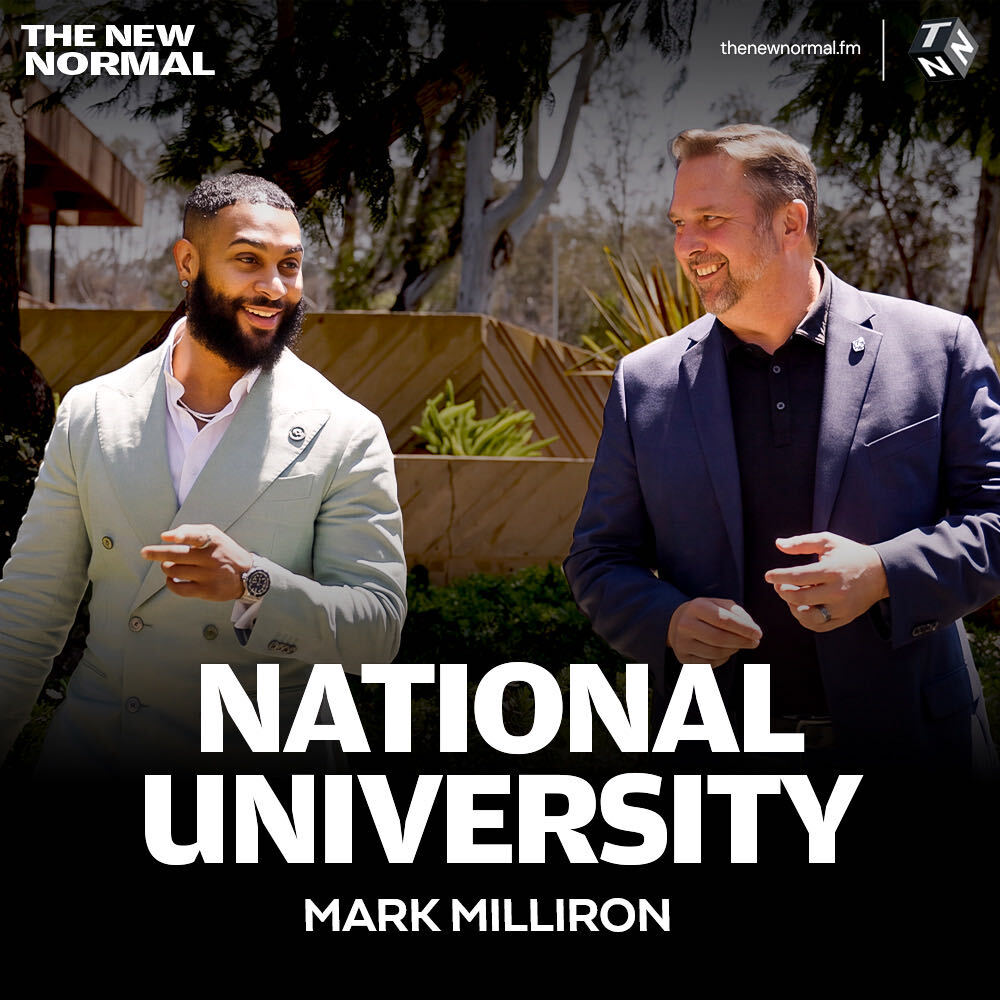











Dr. Mark David Milliron is President and CEO of National University, a private nonprofit founded in 1971 by a former Navy captain and built around military students, working adults, and learners returning to school later in life. He became NU's sixth president in October 2022, arriving after a career that ran through the Bill & Melinda Gates Foundation, where he was Deputy Director for Postsecondary Success, Western Governors University, where he led the largest college of education in the country, and Civitas Learning, the student success analytics company he co-founded. He also serves as Professor of Practice at the University of Texas at Austin College of Education and chairs the Trellis Foundation board.
He is blunt about what AI means for institutions like his: universities that fail to prepare students to use it productively, he argues, come close to committing educational malpractice. His framework asks students to learn about AI, learn with AI, and learn beyond AI, that last piece being the judgment, creativity, and ethical reasoning no machine supplies. It sits inside the approach he calls Whole Human Education, which pairs credential-rich pathways with the holistic support nontraditional students actually need to finish.

National University serves 130,000 learners a year, and almost none of them look like the students higher education was designed around. Nearly all are working. Half are parents. Half of undergraduates are military-affiliated, and the average undergrad is 32. National calls them Anders: students and parents, students and employees, students and deployed. Dr. Mark Milliron, the university's president, grew up in a family of nine kids with 25 foster kids rotating through the house, bused tables to pay his way through Mesa Community College, earned two degrees at Arizona State and a doctorate at UT Austin, then built a career spanning the Bill & Melinda Gates Foundation, an early board seat at Western Governors University, corporate work at Oracle, and the chairmanship of the Trellis Foundation.
Recorded on campus in San Diego, the conversation with OutRival co-founder Rubén Harris covers the Wingman initiative that aims to put an AI agent next to every employee and every student, why grad students were the original AI agents, the four rings that replace a chief AI officer, and RAISE5, the framework that codes every assignment for how much AI a student may use. Milliron argues that his competition is poverty rather than other institutions, that a culture of blame will kill an institution where a culture of wonder won't, and he tells the story of a faculty member who threw his newly installed computer out a second-story window and years later opened his email for the first time to save one student's degree.











.png)