[00:00:00] scott: From our first degree awarded in 2000 to now, we've awarded over a half a million degrees. You know, two-thirds of our people are actually directly interacting with [00:00:10] students. That doesn't happen without a heavy emphasis on technology. Amazon, customer obsession. WGU, student obsession. It's like, it's the same as saying [00:00:20] customer obsession.
[00:00:20] scott: Yeah. Our customer is the student. We have a whole group of folks who are working on designing now the WGU 2.0 model. There's an AI-native one [00:00:30] because we already presumed that the 1.0 model, the one that's gotten us to a half a million grads, et cetera, that it's already past its apex.
[00:00:38] Ruben: Happy Friday. My name's Ruben [00:00:40] Harris.
[00:00:40] Ruben: I'm here with my co-founder and co-host, Timur Meister, and this is The New Normal. The New Normal is a show where we go inside of organizations that are actually using [00:00:50] AI in production at scale in a way that's making a meaningful impact in their organizations. This is not a show about hype. It's a show where we interview leaders that have made [00:01:00] decisions to reimagine their organizations with AI at its core.
[00:01:05] Ruben: Today we're in Salt Lake City at Western Governors headquarters, and I'm excited to [00:01:10] introduce our guest. Timur, can you please introduce the guest?
[00:01:13] Timur: Thanks, Ruben. So, uh, today we're joined by, uh, Scott Pulsipher, the president, uh, of [00:01:20] Western Governors University, the largest online uni- nonprofit university in the country, with 190,000 students, um, all [00:01:30] online, uh, in over, in all 50 states.
[00:01:32] Timur: And, um, what's interesting about our guest is, um, most of the university presidents, they climb the [00:01:40] academic ladder for decades. Scott didn't do that. Scott came from the business and technology world. He spent, uh, over 20 years building [00:01:50] technology companies. He led teams at Amazon, and then he, uh, took a startup and grew their revenue eight times in less than two years.[00:02:00]
[00:02:00] Timur: Um, and in 2016, um, Scott, uh, decided to join higher education and bring that, that experience of scaling, scaling [00:02:10] businesses over to higher ed. And today it's a real treat to, uh, have a conversation with Scott on what him and his team are doing, um, with AI, with [00:02:20] serving the students, um, and also reimagining the future.
[00:02:23] Timur: So I just wanna say, uh, Scott, welcome to The New Normal.
[00:02:27] scott: Yeah, it's great to be here. I certainly appreciate the, [00:02:30] uh, invitation, and I'm sure we're gonna cover some interesting ground today.
[00:02:33] Ruben: Yeah. Yeah. So we always like to start off talking about what is the scale of your university. So can [00:02:40] you give us a sense of the scale, who you serve?
[00:02:41] scott: Yeah. Uh, yeah. Um, today, um, we, in a year, in an academic year, because students [00:02:50] can pretty much start, uh, at any time, uh, they graduate at any time. So in the last academic year, from July 1 of last year to June 30 of this year, we'll serve [00:03:00] nearly 380,000 individuals. Wow. Uh, the concurrent enrollment, Timur, you had right-
[00:03:05] scott: which is that concurrently about 190,000-plus individuals are enrolled right now. [00:03:10] Uh, but what's more important is that this year- Yeah ... we'll graduate nearly 70,000 individuals across bachelor's and master's programs. Uh, we'll have another several thousand completers [00:03:20] across our micro-credential portfolio.
[00:03:22] scott: Uh, just to give you a sense too of that scale over the last, uh, 20 or so years, from our first- Mm-hmm ... degree awarded in 2000 to [00:03:30] now, we've awarded over a half a million degrees. Wow. Uh, so- Awesome ... uh, and we're n- 30 years young.
[00:03:38] Ruben: So- I was definitely gonna ask you about that [00:03:40] because you're, you're a big writer.
[00:03:41] Ruben: You wrote about it on LinkedIn, and you, you had a great post- Yeah ... about that. Can you just talk a little bit more about what it means to serve 500,000- Yeah ... [00:03:50] degrees? You know, I think it's,
[00:03:51] scott: it's... What's core to it is this belief that education is one of the greatest catalysts- Mm ... for people to change their lives for the better.
[00:03:59] scott: [00:04:00] Um, we often, I m- I myself like to say next to faith, education helps an individual start to discover their full capacity, their potential. It certainly increases their [00:04:10] confidence associated with the knowledge, skill, and ability they've acquired to pursue jobs in the world of work that present economic mobility- Mm-hmm
[00:04:17] scott: to them in a way that few other things do. And so [00:04:20] at WGU, we see education as a pathway to opportunity. That's core to our mission statement- Mm-hmm ... to change lives for the better by creating pathways to opportunity. So when you think of that [00:04:30] number, that is 500,000 lives changed. Mm-hmm. Uh, what's also compelling, and I often like to highlight this, is that what you realize is opportunity doesn't [00:04:40] reduce when more people are participating in it.
[00:04:42] scott: Mm-hmm. It actually expands. Mm-hmm. And so what we've seen over that time period is, like, for every one of those degree- Mm-hmm ... holders, those graduates, their [00:04:50] economic mobility has increased. Mm-hmm. They are now acquiring jobs- Mm-hmm ... that are earning them 10, 20, 30,000 or more per year than they were earning before.
[00:04:59] scott: And so you keep [00:05:00] seeing, it's like, well, if it worked for that one, will it work for the next one and the next one and the next 10,000 and the next 10,000? It does. And so what's very different- Mm-hmm ... at WGU [00:05:10] versus much of conventional higher education is that we don't sit there and go like, “Well, our quality is gonna be a measure of how many we let in.”
[00:05:17] scott: Mm-hmm. No, our quality's gonna be measured by how many [00:05:20] lives were changed by education. And so when you think of that 500,000 number, you're like- That's pretty freaking amazing. Yeah, yeah. You're kinda like... And, and for all of us at [00:05:30] WGU, it's so awesome to be associated with something that is having that kind of impact in the world.
[00:05:35] scott: And so last thing I'll just say is like the principle of living 1 by 1 is [00:05:40] like we know that we solve for each individual student, but then you can do that- Mm-hmm ... time and time and time again. Yeah. And so that you can scale your impact, but you do it one individual at a [00:05:50] time.
[00:05:50] Ruben: Yeah. Let's go back to that 300,000 number, and you said- 500,000.
[00:05:53] Ruben: 500,000 number.
[00:05:54] Ruben: Yeah, yeah. But the, the 300,000 students as well. Oh, the three... Yeah. Yeah. You have a staff, right? Yeah. [00:06:00] Us at WGU, how many people serve the, the students? Yeah. And, like, even with that number, I wanna talk about the technology side to be able to take the number of [00:06:10] staff to serve- Yeah ... that many people in that one by one way.
[00:06:13] scott: Yeah. The, uh, for those over 300,000 individuals that we've served this last year- Mm-hmm ... yeah, I see, uh, your point. Mm-hmm. Uh, we have [00:06:20] just over 10,000 employees at WGU. Mm-hmm, mm-hmm. Um, roughly speaking, nearly two-thirds of those are directly interacting with students- Mm-hmm, mm-hmm ... on a daily basis. [00:06:30] Mm-hmm. And so 6,000, 6,500 of our individuals- Mm-hmm
[00:06:34] scott: are interacting with students on a daily basis, um, in a very, you know, c- comparatively [00:06:40] speaking to a conventional context, they're like, I can't think of a uni- institution- Mm-hmm ... that would be able to do that same kind of scale with s- you know, the same 10,000 individuals. [00:06:50] Like, you know, I think of some of the most more traditional institutions, if they have 50,000 students- Mm-hmm
[00:06:54] scott: they probably have 25 or 30,000 employees. Yeah. You're like... And, um, and less than [00:07:00] half of those employees are s- you know, instructing or in serving students or supporting them or mentoring them. You know, two-thirds of our people are actually directly interacting with students. That doesn't [00:07:10] happen without a heavy emphasis on technology.
[00:07:13] scott: Um, and so we often like to say that WGU is a student-centered- Mm-hmm ... tech-first organization. Mm-hmm. Everything that we [00:07:20] do is made better by technology, and so we just have that bias. Uh, that bias also is manifest in our bias for innovation. It's like, it's always about what do you have to do next, [00:07:30] and how do you advance the next frontier of things so that you're achieving- Mm-hmm
[00:07:32] scott: what really needs to happen because we're not slowing down in terms of the number of students we're intending to serve. Mm-hmm. And so if you wanna keep scaling up, [00:07:40] you can't do that without more investment in technology to power the innovation. Yeah.
[00:07:43] Ruben: So not slowing down, so that's consistent with the whole ambition never rests point- That's right
[00:07:47] Ruben: that you were talking about before. Can you talk about [00:07:50] how you set up this technology infrastructure and how it differs from traditional higher ed?
[00:07:55] scott: Yeah, the, uh, I do, we do love that phrase, ambition never rests, and that's true for [00:08:00] all of us at WGU because we know that our students' ambition is not resting.
[00:08:03] scott: And so they, they are ch- they are striving to change their lives, and so we have to strive every day to, to amplify [00:08:10] that ambition. Um, I think from a technology standpoint, one of the first things we did is we actually thought about the student journey as a integrated one, and it's, it's truly from a [00:08:20] prospect all the way to an employed graduate.
[00:08:21] scott: Mm-hmm. And so when you think about that entire journey, uh, the core part of it, of course, is the learning part of it. Mm-hmm. But it begins when you're a prospect. Mm-hmm. [00:08:30] And so we knew that even then you're a human then, and how are we helping you discover how education can help you change your life? How can it help you realize the opportunity that you're pursuing, the [00:08:40] advancement that you desire, everything else?
[00:08:42] scott: But at some point, you enter the learning experience. Mm-hmm. And so we had to think about that in a integrated way, rather than a disjointed set of courses taught by [00:08:50] different faculty members who had an isolated experience with a student, but it was never connected to the next class or even from class, you know, period, class period to class period.
[00:08:58] scott: And so when you, when you [00:09:00] take the technology approach, you start from, well, I have to instrument that entire thing. Mm-hmm. Mm-hmm. And when I say instrument, what it really means is what is the data [00:09:10] model? Mm-hmm. So what are all the interactions that you're supporting that? What's the workflow? Uh, what are all the user experiences that you're have to, having to build?
[00:09:17] scott: And you have to build that in a pretty, [00:09:20] um, unifying way because the human is the constant through all of that. And if you think about, again, the human being- Mm-hmm ... the constant, it's like, well, how are we adapting to you? Mm-hmm. [00:09:30] The difference in that notion is really important because we are striving to adapt to every single individual, but in most conventional thinking, it's like, oh no, we have a standardized [00:09:40] model.
[00:09:40] Timur: Yeah. Yeah. And there's a lot of institutions that say they do online, and online to some could be just, uh, being on a Zoom call- Yeah, yeah. ... uh, and, uh, following a traditional [00:09:50] model, and you guys are certainly pioneering that personalization, personal learning- Yeah ... model. Um, I'm curious, given your background, um, being at Amazon, [00:10:00] being in the technology world, what lessons have you brought from kind of the business technology world- Mm
[00:10:05] Timur: to, uh, serve the student who is online, who is learning, [00:10:10] probably a working adult?
[00:10:11] scott: Yeah. Um, there's a number y- there's a number of things, and whether it was at Amazon or other organizations- Mm-hmm ... like this, I think a couple things that are [00:10:20] really important is that it was happening at WGU before I came here, meaning, uh, this core thing was being lived at WGU before I was here that also was actually core [00:10:30] to Amazon.
[00:10:30] scott: Mm-hmm. And that is the customer obsession. Mm-hmm. You have to be really, really clear- Mm-hmm ... about who the primary beneficiary is of everything that you're doing [00:10:40] at your organization. And one thing that's really clear at WGU is the student- Mm-hmm ... is the primary beneficiary of everything that we do. And so this notion of Amazon [00:10:50] customer obsession, WGU student obsession- Mm-hmm
[00:10:52] scott: is like it's the same as saying- Yeah ... customer obsession. Our customer is the student, and we obsess about delivering the value for [00:11:00] them. Because if we don't deliver it for them, everything else fails. You know, providing ready graduate to employers, that fails if you can't- Mm-hmm ... actually help the student complete.
[00:11:08] scott: You know, doing that at a low [00:11:10] cost, well, that also fails if you can't help the student- Mm-hmm ... persist and complete, et cetera. So you have to be student-obsessed. And, and the key part of that is saying that, well, guess what? In a [00:11:20] digital first organization- Mm-hmm ... like WGU or like Amazon, the one thing that, the one person who's never in the room with you when you're devising all these solutions and [00:11:30] models and everything else is the customer.
[00:11:31] scott: Yeah. Mm-hmm. So you have to sit there and say, “Oh, no, we're obsessing about that individual, and so what is all the perspective we can bring to our design [00:11:40] from the perspective of the student?”
[00:11:41] Timur: Yeah. And, uh, I, I know a lot of businesses, they'll run, like, a net promoter score- Yeah ... C-SAT, customer satisfaction score.
[00:11:49] Timur: [00:11:50] Um, how are you guys measuring, uh, what are you looking at in terms of, uh, that cu- that student obsession and how you're-
[00:11:56] scott: Yeah ... measuring it? Yeah. We actually do look at that a lot, and so we actually do have [00:12:00] a net promoter score. We also have overall student g- or graduate satisfaction. Mm-hmm. Uh, our NPS is often range in that 70 to 75 range.
[00:12:08] scott: Again, when you think of those who are [00:12:10] comparable to that, you're talking about products like Apple, you- Mm-hmm ... places like Amazon, et cetera. And you, when you also look at comparatively to higher ed is, like, well, it's twice as high- [00:12:20] Mm-hmm. Mm-hmm ... as, you know, higher ed in general. We also look at overall graduate readiness and graduate outcomes.
[00:12:25] scott: The other thing we look at is employer satisfaction. Mm-hmm. Like, the number of our [00:12:30] employers who say our graduates- Mm-hmm ... are as good or better in terms of their preparedness is also higher than traditional institutions. 100% of our employers in most recent surveys are hiring WGU [00:12:40] graduates again, so you know that you're also delivering- Mm-hmm
[00:12:42] scott: a ready graduate for that employer. The other thing I would say that, uh, to your original question, Timur, in terms of what [00:12:50] I think has helped us at WGU, um, from my own perspective of working at Amazon when I did, is that whenever there was a s- a challenge or, or a [00:13:00] problem- Mm-hmm ... or a outcome that had a high degree of variance for what was intended, they had the default thinking to say, “Well, it's a process problem.”
[00:13:08] scott: Mm-hmm. That you didn't [00:13:10] actually design the process well- Mm-hmm ... to be highly repeatable and therefore scalable. The other reason it's a process focus is because the humans, meaning there are employees that do that process, [00:13:20] they're gonna come and go. Mm-hmm. But the process actually is paramount- Mm-hmm
[00:13:23] scott: there's, in the sense of like, if you really wanna design something to achieve a particular outcome- Mm-hmm ... this, you know, you know, [00:13:30] graduate or call it the student persistence, you know, learning at pace, you know, course completion rates, overall, you know, like- Mm-hmm ... on time progress, end completion rate, [00:13:40] graduation rate, et cetera.
[00:13:40] scott: If those are key outcomes you're trying to achieve, and part of that is the input to the learning- Mm-hmm ... the mentoring, the support, et cetera, and you have all these other input metrics. If the [00:13:50] outcomes are, are different or highly variant- Mm-hmm ... from what you intend, you look at the process like, “Is there something messed up in the process?”
[00:13:57] scott: Yeah. And what should the process be to [00:14:00] increase the consistency at which we're delivering a high-quality experience? Mm-hmm. And if you design that, then the humans that do it come and go, but the process keeps improving [00:14:10] and are innovating around that. And so I think for us, when you go from... In the 10 years since I've been here, when I joined, we had about 65, 70,000 concurrent students.
[00:14:19] scott: You heard the numbers [00:14:20] we have now, nearly 200,000 concurrent students. You know, when you think of the, you know, the number of graduates, I think we were under 100,000 total graduates in the year- Wow ... I joined, and we're [00:14:30] now over a h- half a million. Awesome. And you're like, okay, for that to scale- Yeah ... you can assume that WGU has highly repeatable practices.
[00:14:37] scott: Mm-hmm. Yep. That many individuals over [00:14:40] that time period have come and actually do well and improve and innovate, et cetera. And so that's another thing that, that I think, uh, I learned in working a highly scaled- Mm-hmm ... [00:14:50] customer-obsessed organization like Amazon.
[00:14:51] Ruben: Yeah. And you did that in less than 10 years. And like when I
[00:14:53] Ruben: think about customer obsession, student obsession, personalization, and those numbers you just talked about, [00:15:00] to get hundreds of thousands of students enrolled, you actually have probably millions of leads you have to go through. Oh, yeah. And so- Yeah ... um, you talked about serving the student [00:15:10] from prospect or initial inquiry to, you know, starting the application all the way to being a graduate.
[00:15:16] Ruben: Can you talk about your thoughts on how to serve [00:15:20] people with technology in that larger funnel- Yeah ... like on the enrollment management side? 'Cause right now there's hundreds or even thousands of people that are talking to these students that have various [00:15:30] levels of intent. Yeah. So tell us a little bit about how you think about that.
[00:15:33] scott: Yeah, you know, we, uh, uh, you're right. Th- so for example, roughly between 15 and 20% of our new [00:15:40] stude- of our prospects, uh, those that are applicants- Mm-hmm ... end up actually starting- Mm-hmm ... at WGU in, uh, you know, from the first time they apply in the next 12 months. That kind of the attribution [00:15:50] window that we see, which means that, you know, for every one new start you're, you have s- you know, s- five to seven, you know, prospects.
[00:15:58] scott: Yeah. Mm-hmm. And so you have [00:16:00] millions of individuals coming every, every year. This last year I think we enrolled over 150,000 new individuals- Wow ... that started at WGU. Um, so I think about it [00:16:10] this way, is like, um, think of the moments of truth that exist for an individual who is starting to believe that education is something they need to pursue [00:16:20] And when I say moments of true, it's like- moments of truth, it's like key questions they have to answer to know whether WGU is right for them.
[00:16:26] scott: And it's, first of all, is like, well, why education? [00:16:30] Mm-hmm. And so it's a conversation about- Mm-hmm ... what opportunity you're pursuing, what vocation do you actually intend to go into? How do you see yourself contributing to the world? And so do you have a sense [00:16:40] of like how are you connected to the purpose of education in the first place?
[00:16:43] scott: So how do we help them discover the answer to that question in that prospect to a, a new start journey, a new student journey? [00:16:50] The other key question is like, you know, all right, uh, which program is right for me? Like- Mm-hmm ... if I have, oh, I know health, et cetera, well, which program is [00:17:00] right for me? 'Cause the one thing at WGU that's not true at most other institutions, when you start at WGU, you actually start in a program.
[00:17:06] scott: Mm-hmm. You effectively declare your major the day you start. Mm-hmm. [00:17:10] And so that's not a typical thing is like you can wander around in your gen eds and stuff like that. You got that first, you know, 12 to 24 months to figure out what- Mm-hmm ... you're gonna declare. But you also [00:17:20] have to figure out like whether you're prepared for the WGU learning environment.
[00:17:23] scott: It's like, all right, what's your kind of prior academic track record? What are your daily habits and behaviors and things like that? Because much of [00:17:30] the digitized immersive experiences, it depends upon the- some, you know, self con- you know, governance or self-management- Yeah ... et cetera. And so we wanna understand is like what kind of [00:17:40] behaviors you...
[00:17:40] scott: All right, are you now ready kind of for WGU, and what are the other things? The, the things you are also have to solve for are the easiest, which is how are you gonna pay for [00:17:50] this? Mm-hmm. You know, uh, is it affordable? Mm-hmm. You know, what kind of time do you have available? Like, those are easier to solve.
[00:17:54] scott: It's these other more important questions that are moments of truth.
[00:17:58] Timur: Yeah. Yeah. And w- so R- Ruben [00:18:00] and I spent probably more, um, more years thinking about the journey of guiding people and enrolling them that, um, kind of we care to admit in terms of just- [00:18:10] Yeah ... the sh- number- Yeah ... of thousands of calls, thousands of conversations with students.
[00:18:14] Timur: Um, my personal learning is that there's gonna be some people that drop off 'cause they [00:18:20] hit some friction, some roadblock along the journey. Mm-hmm. I think, um, AI now is just another toolbox, um, along with [00:18:30] online, along with, uh, other tools that schools are, uh, able to utilize to get more people to start to the finish line.
[00:18:38] Timur: I'm curious, um, how are [00:18:40] you thinking or, or how, how is, uh, WGU deploying AI or agentic workflows- Yeah ... to ensure that you're removing friction, so if someone decides not to [00:18:50] complete something, it's kind of made by their choice, not them falling through the cracks?
[00:18:54] scott: Yeah. It's actually a really key point is like- That it's their reason that they're falling out- Yeah
[00:18:59] scott: not because of a [00:19:00] failure in our practice.
[00:19:00] Timur: They missed an email- Like that's a- ... or they, uh, got stuck with their transcript- Yeah ... you know?
[00:19:03] scott: Yeah. Um, I, we, I think we think about it this way, and this is probably true for any phase of our, of our student [00:19:10] journey, which we simply break down into kind of three phases.
[00:19:12] scott: Prospect to s- new student. Mm-hmm. New student to graduate, graduate to employed. Mm-hmm, mm-hmm. So this, uh, employed alumni. [00:19:20] And we think about those three phases. In every one of those phases, you have to kind of break down what are those moments of truth or what are those tasks- Mm-hmm ... that have to happen and what are the engagements that need to occur, et cetera.
[00:19:29] scott: [00:19:30] And they kind of go along, this is oversimplifying, but it's along a continuum of what are those more simple ones versus what- Mm-hmm ... are the really complex ones. On the really simple ones, you [00:19:40] actually don't even really need AI, you just need to automate the heck out of it. Mm-hmm. 'Cause, like, it should be as self-service as possible.
[00:19:46] scott: But really self-service means how is the system doing for you [00:19:50] that which you really shouldn't have to do for yourself? Mm-hmm. Uh, there are things that move along that example, I would say, within the middle of this frame. Like, well, one of the biggest considerations for our students in the [00:20:00] prospect journey- Mm-hmm
[00:20:01] scott: is that they have some prior college. Mm-hmm. And so we're transferring in and, you know, a lot of credit on behalf of these individuals. Like, well, that's actually somewhat [00:20:10] complicated. Mm-hmm. What are the institutions you went to before? Like, uh, ca- Yeah ... how easily can we pull transcript, et cetera? And so we start utilizing an AI-enabled or a [00:20:20] data- Mm-hmm
[00:20:20] scott: enabled model by which you can create a transcript broker service. That's simply what we call it, which is you just need- Yeah ... to provide us the institutions you went to, and we have your name, [00:20:30] so we're gonna go start pulling the transcripts- Yeah ... on your behalf so you don't have to go do it. And then when we pull that, we also have the transcript evaluation, which is, this is actually where AI becomes more [00:20:40] important because mapping, uh, from a course at another institution to a course at WGU, unless you have a direct, like, language map- Mm-hmm
[00:20:49] scott: uh, [00:20:50] you kinda have to infer a lot of things. Like, well, what were the learning outcomes of that class, and do they map to the learning outcomes of our class? It's like, and can we do that? Well- Yeah ... a lot of cases, over [00:21:00] half of the community colleges, we have direct articulation with. We n- have done all the course mapping.
[00:21:03] scott: Yeah. But for a lot of other schools, we don't have that. And so this is a good example where AI is actually just in [00:21:10] the background- Yeah ... powering this ability to map that. But then you get to more complex things, which is now into the advising. This is where you can utilize, uh, agentic AI to [00:21:20] allow to say- Mm-hmm
[00:21:20] scott: actually, given all the information we have from WGU- Mm-hmm ... and the history of serving over a million individuals and 500,000 graduates- Yeah ... we already know that we [00:21:30] can inform that AI agent in a way that an enrollment counselor that we hired off the street and tried to train is not gonna have the same level of expertise.
[00:21:37] scott: Mm-hmm. So you can start [00:21:40] providing a pretty personalized, immersive experience with AI agents in a way that we had to utilize a lot of humans before. But that only goes so far. It may answer, if you will, the [00:21:50] technical questions- Yeah ... about, you know, what's right for me and what opportunities exist. But when you're getting to down to core human aspects around, listen, you do, in, in the [00:22:00] Stuart Smalley version of old SNL skits, like, “Listen, you're already good enough.”
[00:22:04] scott: You already have that inherent worth. You already have the innate capacity- Yeah ... for doing it. Let me talk to you about all the ways in which we have put [00:22:10] in, you know, services and models and mentoring, et cetera, to help you persist and be resilient- Mm-hmm ... through this journey. Because a lot of that is just like a human connection that says, “I'm gonna [00:22:20] be able to do this.”
[00:22:20] scott: Mm-hmm. I have the courage and confidence necessary to begin because in talking with that individual, I now know that I'm prepared to actually proceed through this [00:22:30] journey. That's vitally important. I just don't think that that connection is gonna happen by an AI agent. Yeah.
[00:22:35] Ruben: You know? So- I love that you, you started talking about AI agents now.
[00:22:37] Ruben: So let's- What is your [00:22:40] definition of the difference between a chatbot, a copilot, and a AI agent? And then I love that you talked about moments of truth and the human element. Yeah. So after you [00:22:50] define it, help us understand what type of work is amazing- Yeah ... and perfect for a agent or a digital worker- Yeah
[00:22:58] Ruben: versus a human and how they work together.
[00:22:59] scott: [00:23:00] Yeah. You know, uh, it's interesting. I would probably go back to describing a AI agent. I think you do have to get back to the fundamental def- definition of an agent. Mm. An agent is someone who has [00:23:10] authority to act beyond, on behalf of a principal. Mm-hmm. Uh, so to define an AI agent is like, well, first of all, the agent's acting on behalf of which principal?[00:23:20]
[00:23:20] scott: And so a lot of our cases, like, it's acting on behalf of our principals. Those principals include our course instructor, or let's start back to the journeys. Like, well, those are our enrollment counselors. Those are the principals [00:23:30] in that experience. Mm. They have the responsibility to support those prospective students.
[00:23:33] scott: Then once you're in your learning journey, it's like now it's our mentors. Like, oh- Mm-hmm ... we have all the onboarding- Mm-hmm ... experience for you, and the, the mentor's the principal. Now, the mentor [00:23:40] persists throughout your entire journey, but you also have course instructors for- Yeah ... specific courses, et cetera.
[00:23:46] scott: They're the principal. You may have an evaluator that's part of that. You may [00:23:50] have just even some student support and student services. You may have a career serv- y- you know, career advisor. All these are individuals- Mm-hmm ... that are providing high value add [00:24:00] interactions with students for whom you can start designing agents to say, “If that agent, empowered with all that knowledge base that exists within-” Mm
[00:24:09] scott: those humans are [00:24:10] providing it, can it inc- increase the capacity of those a- principals- Mm-hmm ... if you will, in a way that you can start supporting more and more students?” But it also has to be done in a way [00:24:20] that the agent is as personalized in their engagement as the human would be. They're discovering what is motivating- Mm
[00:24:26] scott: the in- individual student, et cetera. They're do- You know, they have all the [00:24:30] context of what, are they in this course- Mm-hmm ... and they've pa- failed or passed this assessment? Like, what's the dynamics- Yeah ... of going on? That the power of the AI agent is says it is [00:24:40] reasoning like the individual principal would be in support of that student.
[00:24:44] scott: It's not gonna be perfect. Mm-hmm. That's the thing we're learning, because guess what? The data set that's available [00:24:50] to the agent, as broad as it is, it still lacks some of that human component. Now, the other side of that is an agent can also act on behalf of the student as the principal. [00:25:00] Mm-hmm. So if you think of the content world, I was bringing up this example as like, well, that's interesting is, like, if I had an AI agent and it could just [00:25:10] consume the lecture content that my professor gives three times a week, and it could just ingest all that- I could ask my agent or basically tell the agent to say, “Listen, I need you to [00:25:20] synthesize all of that down into the core learning outcomes I need to focus on.
[00:25:24] scott: I also want you to go get other third-party resources to actually fill in all the gaps around that. I want [00:25:30] you to develop a study plan for me. I want you to now be my, you know, my co-pilot instructor next to me 'cause I need...” Actually, you could create five agents and you had [00:25:40] your own AI agent-powered study group now.
[00:25:42] scott: Mm-hmm. Yeah. It's like it's just one human and four or five agents. You know, like, you can see how that even agents can act on behalf of a student too, that is- [00:25:50] Yeah ... the principle. I think in our design of those agents, uh, we are trying to, how do we amplify the capacity of the humans to serve more and more individuals?
[00:25:59] scott: [00:26:00] Such that if you even think about the productive output of a mentor today, roughly speaking, we're somewhere between 80 and 100 students to one mentor. But 80 and 100 students don't [00:26:10] all need the same level of mentoring engagement. But they all need engagement. And so if that one mentor can provide the uniquely human connection with those individual students, [00:26:20] but if it varies across 80 or 100, then how much could one principal mentor support if they also had agentic AI for mentoring to support all these other lower value [00:26:30] mentoring things across 200 students now?
[00:26:32] scott: Mm-hmm. And now one mentor can have a much more productive output to say, “Oh, you can support many more.” Mm-hmm. I think that's [00:26:40] how we kind of think about the agentic experience versus just a co-pilot, which often you see as, like, it's information sourcing, it's answering my questions. It's kind of reactive, I think [00:26:50] you would call it, Ruben.
[00:26:50] scott: Mm-hmm. It's like, “Ah, no, I just have to solve a problem right now. It's immediate. Just give me the answer.” Mm-hmm. Mm-hmm. Like, that's not what we're designing for. Mm-hmm. Mm-hmm. We're designing for learning, and the human is [00:27:00] ultimately the one learning, even if that learning is enabled further by an AI agent.
[00:27:04] Timur: Yeah. You know? And I, I really like the example that you brought, like the student having an agent that [00:27:10] represents them. Them. Um, as we speak to a lot of, uh, higher education leaders, there's always, like, the topic of, like, our faculty's complaining [00:27:20] 'cause students are using, uh, ChatGPT, uh, to write essays.
[00:27:23] Timur: Yeah. We'll, we'll ask this question to every leader we meet, uh, just to get a... It's a philosophical question, but, uh, [00:27:30] what is your thought on, like, students using, um, AI to complete assignments- Hmm ... writing essays? Is that considered cheating, or is that just them [00:27:40] being, um, kind of savvy in terms of this technology use?
[00:27:44] scott: Uh, I think it's being pretty savvy, honestly. It's like, because I think what we would distinguish is, like, [00:27:50] assignments are one thing. Like, homework- Mm-hmm ... doing the homework is one thing. Um, I think most pro- you know, professors and teachers in the past, like, homework was critical to the learning experience- Mm-hmm
[00:27:59] scott: [00:28:00] for the individual, that it was... Uh, we know this from a recent study- Mm-hmm ... out of Carnegie Mellon in 2023. The, uh, the title of which was An Astonishing Rate of Regularity, or [00:28:10] Astonishing Regularity in the Pace of Learning- Mm-hmm ... or Rate of Learning, which basically said for any concept, a human needs, like, seven practices- Yeah
[00:28:18] scott: uh, to develop mastery. It's [00:28:20] like, so homework was a way by which individuals got the practice. It's like, I gotta keep solving problems. Mm-hmm. It's like word, it's like word problems in math. It was like, uh, you know, this car traveling at this [00:28:30] speed, go this di- You're like, “Okay, I gotta do a lot of those to start-” Yeah
[00:28:32] scott: like, being able to process how you handle this. And, and- Now, if those assignments were also a way to kind of assess [00:28:40] an individual's learning, like, then you probably missed it. Because, uh, they can utilize AI to do work. Mm-hmm. But in fact, we are about [00:28:50] assessing whether or not the human has actually learned and can demonstrate the competency necessary in those learning outcomes, and we're not in any way, uh, [00:29:00] allowing, or nor should any institution allow, an individual to take an assessment with their AI agent or AI copilot.
[00:29:06] scott: Yeah. Yeah. Because then you're just assessing the copilot. Like, I already know the [00:29:10] copilot's smart. I- Yeah ... I know it can answer all these questions. I know it can pass the LSAT. Like, it already can do all these things. But you can't allow that. Mm-hmm. But, so going back to the [00:29:20] work is like, well, maybe you have to think differently about assessments.
[00:29:23] scott: Mm-hmm. Instead of midterms, maybe you have continual assessment. That's kind of a design that we're going to, which is you actually need to [00:29:30] have not- don't call them knowledge checks. They're actual continual assessments. Mm-hmm. Like, I can't really discern whether or not you did the work with an AI copilot or not, but I can [00:29:40] actually assess you continually as to- Mm
[00:29:41] scott: whether you're developing mastery of the concepts as we progress through this course, rather than, oh, I've only got a midterm here, and I've only got a midterm there. Mm. Or [00:29:50] even I just have a final So I think there has to be a way by which you're always assessing the competency development of the individual- Mm-hmm
[00:29:57] scott: not just I did work that I [00:30:00] short-circuited- Yeah ... because I used AI as a copilot.
[00:30:02] Timur: No, totally. Yeah. And, um, my, my grandma, she's, um, she's 96. She, she's a former math teacher. And so, like, growing up, like, you're [00:30:10] solving math problems- Yeah ... not because you can... You're getting to the right answer. Like, every textbook has, on the last page, right?
[00:30:17] Timur: Yeah. Like, at the end of the chapter, it gives you the [00:30:20] answer, but you still need to show the work. Yeah. You still need to solve the problem. That's right. So, um, I think it does come down to, like, that student experience and journey. I think [00:30:30] especially with a lot of working adults who are learning, like, they're not doing it just to check a box.
[00:30:36] Timur: Like, they actually are doing it to get a job, and you're not [00:30:40] bettering anyone just by kinda skipping to the answer at the end of the textbook.
[00:30:43] scott: Yeah. You know, uh, I think of the simple concept of time value and money. Mm-hmm. I still know and understand all [00:30:50] the equations, and I know and understand the principle of compounding- Mm-hmm
[00:30:53] scott: et cetera. That I can go on a standard calculator and compute, like, oh, what's your in, in, you know- Mm-hmm ... you know, [00:31:00] IRR on that, and what's your kind of net present value of this given these terms? Mm-hmm. Like, I can figure out the payments. I could do it with just the equations because I understand that.
[00:31:07] scott: Mm-hmm. But someone today, even [00:31:10] my, you know, one generation later, my own kids, like, the ones in finance, like, do you think they actually know those equations the same way? They plug it into Excel. Mm-hmm. They plug it into some formula. Yeah. Like, [00:31:20] but does it make them any less competent in actually being able to do the math associated with, you know, time value of money and investments- Mm-hmm
[00:31:27] scott: and things like that? Probably not. They're actually [00:31:30] just technology fluent- Yeah ... for the tasks that they have to do today. Well, the same is true for AI fluency in all those different jobs, is like you have to assume that the work that you're gonna be doing is different [00:31:40] because- Mm-hmm ... you have the AI capability as the support for it.
[00:31:43] scott: And one like myself, who holds onto that is like- Mm-hmm ... well, I myself know that, like, I don't... I [00:31:50] could do it on a calculator, but I don't need to, and I can shorten the time that I spend on that. Yeah. Anyway, this, this idea that says, “Hey, uh, even in a AI-enabled world-” [00:32:00] It's the human who has to decide whether or not I, what could I do and what should I do- Yeah
[00:32:06] scott: and whether the reasoning is actually makes sense. And, you know, like, if even if you [00:32:10] give me an answers like, “Well, what were all the inputs into you getting that answer?”
[00:32:14] Timur: And was that the right answer? 'Cause the-
[00:32:15] scott: And was it even the right answer? Yeah. It's like because the things that we are, we as humans [00:32:20] are really good at, are dealing with new problems, meaning ambiguous ones- Yeah
[00:32:23] scott: for which the outcomes are not certain. You're kinda like, “Let me reason through that.” The AI can help that, but it's not gonna be [00:32:30] able to think like a human in the same sense that like, “Oh, yeah, there's all these other contexts that weren't put into the model, that the output of which will actually exclude those [00:32:40] variables.”
[00:32:40] scott: Yeah. And so the human has to still be the principle.
[00:32:42] Ruben: Yeah. Yeah. I mean, I was an investment banker for three years, and like- Yeah ... to your point, like, a model's a model, right? A model's a model. And so a human is gonna be tweaking different scenarios, [00:32:50] they're gonna be doing sensitivity analysis. And Tim and I were just joking about how even though we're building models from scratch, now Claude can make a model way easier than we can.
[00:32:58] Ruben: Yeah. That's right. And so I like that [00:33:00] you're talking about economics now. Yeah. Because it is important to know- It is important ... economics as a leader. Yeah. Um, we've seen like Clay Christensen talk about the future of universities, whether [00:33:10] some are gonna exist or not. Yeah. Some of them are not doing so well.
[00:33:12] Ruben: Some of them wanna do better- ... and are trying to figure out how to change and how to leverage technology to adjust. So can you talk about the [00:33:20] economics of a university? Yeah. How technology can either help them and- Yeah, what steps they could take Yeah.
[00:33:27] scott: The, uh, you do have to st- [00:33:30] understand your institution's unit economics, as I call it.
[00:33:32] scott: Mm-hmm. Uh, the unit is what is the thing that drives the revenue and all the costs? Mm-hmm, mm-hmm. And, uh, in our case, it's [00:33:40] simple. It's a student term. Uh, so that is our primary driver because, uh, n- nearly 100% of our revenue is driven by the number of students who are [00:33:50] paying tuition. Um, and that's also the driver of two-thirds of our costs too, because there are direct costs of delivery to supporting those students, whether it's in content or [00:34:00] whether it's in, uh, mentoring or whether it's in instruction, whether it's in evaluation, et cetera.
[00:34:04] scott: Then there's other costs that you have to understand. Program development costs, how quickly can you develop those costs? Mm-hmm. There's [00:34:10] some other technology costs. It's a heavy part of our academic experience, is like that, you know, that's 10 to 15%- Mm-hmm ... of your total spend because you have to put in all the, in place all those [00:34:20] systems.
[00:34:20] scott: But you'll notice in our u- unit economics what it does include are facilities. Mm-hmm. It doesn't include boarding and housing. It doesn't [00:34:30] include, uh, you know, all the boarding, all the food options and all the other student experiences.
[00:34:34] Timur: And, and, and on the topic of, uh, learning online, um, we do speak to a lot of [00:34:40] presidents, a lot of provost leaders who are realizing that online is the kinda next frontier, the next opportunity.
[00:34:47] Timur: Um, obviously very [00:34:50] few, uh, higher ed institutions can be at your scale- Yeah ... hundreds of thousands of students, but I think for some schools, uh, getting to 10,000 online [00:35:00] students, 20,000 online students is, um, a 20, 2030 goal, right? They have very- Yeah ... ambitions for their, like, local market, for their student.
[00:35:09] Timur: They might have a great [00:35:10] brand. Um, what advice do you have for them if they have to rethink- Yeah ... how they're gonna be building their online arm? Um, if you were giving advice to kinda someone [00:35:20] just starting out, or maybe they have a few low thousands and they're- Yeah ... looking to get to 10,000, what should they focus on in terms of hel- helping them get to that strategic goal?
[00:35:29] scott: Um, [00:35:30] a friend of ours, uh, f- some time ago who used to lead kind of Harvard's online program, and now I think he's the dean of, uh, the School of Business at Tufts, [00:35:40] um, Bharat Anand, he actually had this phrase of, like, avoiding the replication trap. So, you know- Mm-hmm ... the first piece of advice would be if you're gonna go online, [00:35:50] uh, don't think about the modality of online.
[00:35:52] scott: Think about the tech-first design, about that digitally- Mm-hmm ... digital-first, highly personalized, immersive learning [00:36:00] experience, that you have the potential in that in- experience to personalize the instruction, the content traverse, the d- course traverse, everything else like that, the evaluation assessment.
[00:36:09] scott: [00:36:10] Everything you have the potential to reimagine- Mm-hmm ... how it's actually designed and delivered, and you avoid the... In doing so, you avoid the replication trap, which is you don't just [00:36:20] take your three classes a week that I now have to have- Mm-hmm ... you know, a faculty deliver content as a lecture. Like, if you just move that [00:36:30] online, like, you miss the opportunity because it's, uh, it's a pretty low value add for the individual student.
[00:36:37] scott: You're gonna have a tough time [00:36:40] Acquiring students into experience that basically replicates the existing one in person, but it's just online. The biggest challenge with that is you're gonna try to put on a schedule. Really? I'm like, what about [00:36:50] online is on a schedule today? Mm-hmm. I stream what I want to on Netflix- Yeah
[00:36:52] scott: when I want to. You know, like, it's not about your schedules, you know- Yeah ... faculty member, it's about my schedule. The other thing I would [00:37:00] say is, like, if you're gonna go online, be really clear about what the profile of the students or the segments of individuals that you're really gonna serve. This is...
[00:37:07] scott: We didn't talk about this, but one that I think the [00:37:10] real differentiators of WGU- Mm-hmm ... is that we design that experience for individuals who may have had some college but not completed. Mm-hmm. For individuals that are working, that already [00:37:20] have massive- Mm-hmm ... constraints on their available time, who may be from lower income backgrounds.
[00:37:24] scott: Uh, more than, you know, about- Mm ... 50% of our students are Pell eligible. Of, you know, about [00:37:30] 30% of them are even living, you know, at less than $35,000 per household. Mm-hmm. You know, like, so guess what? Affordability is a huge issue, and that includes even travel and gas costs to go to a campus. [00:37:40] Like, but time is at a premium, and so we design in a way- Mm
[00:37:43] scott: that says you actually had to serve a different type of profile of a, of an individual because of all the dynamics they're dealing with, [00:37:50] so that you can design for that. Uh, in my sense, I would tell all of them to say, be really, really clear about what the needs are of the individuals- Mm-hmm ... you're gonna serve for those segments that [00:38:00] you target.
[00:38:00] scott: Second, rethink the entire experience with a digital first mindset, and don't assume that what you're doing currently is what you should just be replicating- Mm-hmm ... online. The [00:38:10] third would say, given that design, completely rethink your cost model. So back to the economics is like, actually, they should only be paying for what's really [00:38:20] the cost of delivering that, and it's totally different versus what you saw most online do is like, oh, to not devalue the, you know, the supposed reputation of our [00:38:30] degree- Mm-hmm
[00:38:30] scott: we're gonna charge the same price online for the what's in person. But you mostly said, well, we're gonna serve the exact same student then. Mm-hmm. Someone who has the ability to [00:38:40] pay and, et cetera. Yeah. You know? Versus, like, actually that's not your cost to deliver that. Like, what's really the cost of delivering that?
[00:38:47] scott: They don't take... avail themselves of all the student [00:38:50] services, the room and board, et cetera. So s- those are some of the things I would say. The last thing is actually much more of a leadership issue, which is, uh, Clayton Christensen, you referenced. Mm-hmm. He would [00:39:00] tell you that, said, you know, disrupting from within is ridiculously hard.
[00:39:04] scott: Mm-hmm. You're probably better served to stand up a unit whose only job is to design that new one and [00:39:10] has no accountability for performance or outcomes of the existing one, because then they don't care about any of those constraints. There's like- Yeah ... “Ah, we're a startup. We're just designing for new.”
[00:39:19] Ruben: Mm-hmm. Tell [00:39:20] us about the forming of WGU- Yeah ... and if that's a model for the rest of the country, because you did this in what, nine years?
[00:39:27] scott: Yeah. The, uh, I mean, the [00:39:30] funny thing is, like, we're coming up on our 30th years from its original founding. It was incorporated in January of 1997. Mm-hmm. Uh, we had our first graduate in [00:39:40] 2000.
[00:39:40] scott: Wow. I think at the first commencement, Governor Leavitt came to it and I think there was, like, three graduates, you know? Mm-hmm. There's, like, more people than graduates, you know? Uh- ... you know, Bob Menhal [00:39:50] was there, Governor Leavitt was there, et cetera, so it's kind of amusing. Um, and, uh, I do think that, um, if you consider what [00:40:00] education needs to do and how it needs to be aligned with the future of work and opportunity, the diversifying of the population, like, the dynamics that exist around those who aren't participating today [00:40:10] in higher education, et cetera, like, you have a huge, huge problem to solve.
[00:40:13] scott: Like, you need to have greater, greater expansion. And this was before the advent of AI and how dramatically it's [00:40:20] changing the world of work because now you have 170 million people already in the workforce. Mm-hmm. And you could argue that easily tens of millions of those need to be upskilled and reskilled right now- Yeah
[00:40:29] scott: [00:40:30] and they're not gonna go back and enroll in, like, college. Mm-hmm. Yeah. But guess what? They all need higher order learning that needs to be delivered by somebody because- Mm-hmm ... the employers don't know [00:40:40] what is the curriculum and how to deliver it, et cetera. And so if you thought more expansive around- Mm-hmm
[00:40:44] scott: the market, if you will, the students or humans to be served, it's like every [00:40:50] institution of higher ed should be looking at that and go like, “Whoa, we're, we gotta get going- Mm-hmm ... really, really fast.” So to your question is, I think these [00:41:00] governors, Governor Leavitt and Governor Romer in particular, were so visionary at the time because the internet was just beginning.
[00:41:07] scott: It was like '96 when, when they were doing all the [00:41:10] work. Mm-hmm. And you're starting to go like, “Wow, this internet should allow us to actually change the nature of access,” which is we can bring the education to them rather than requiring them to come [00:41:20] to a campus. Similarly, Governor Romer was saying, “You know what?”
[00:41:24] scott: Uh, he was a pilot. He often talks about, like, “When I get in a plane, what I care about the pilot, [00:41:30] I wanna know whether he's competent or sh- he or she is competent to fly the plane.” You're like- Mm-hmm ... “I don't really care whether you went to that school or this school, et cetera. I just need to know, like, do you know what you're doing?”
[00:41:39] scott: You know? [00:41:40] And, and he kind of was... That thinking was behind the competency-based education design. That what it emphasizes in the world [00:41:50] of learning or knowledge, skill, and ability, competency is actually what matters. Mm-hmm. And when you think of that, they kinda said, “All right, so if the internet [00:42:00] as the kinda digital age, if that can democratize access, how do you utilize a competency-based model to let every human actually personalize [00:42:10] or customize their traverse through the education needed?”
[00:42:12] scott: Because now you and- Mm-hmm ... you and I can, and every other individual, they can leverage the knowledge they're gaining from all their lived experiences, their work [00:42:20] experience, military experience, et cetera, and accelerate through that which they already know, and spend time on the areas that they don't. But if you did that in a conventional context, like, [00:42:30] sorry, you still have to be in that class for 15 weeks, even if you already know it.
[00:42:33] scott: Or, “Hey, I don't know this, and I need more than 15 weeks.” Mm-hmm. This competency-based model- Mm-hmm ... it says actually the [00:42:40] time is the thing that varies. And then guess what? In most cases it doesn't take me as much time. But we fixed this model, which is by the way ties back to the economics, too, which [00:42:50] is we fixed this model that said it was eight semesters, four years, that's a degree, that's how long it should be.
[00:42:55] scott: That's gonna be a hallmark of quality. And that thing's existed for a [00:43:00] century, but then you also built all the economics around that. Like, well, what if students were finishing in two years? Yeah. Like- Wow ... I can't get a return on my, uh, cost of acquisition. Mm-hmm. Yeah. You're like, but they [00:43:10] finish in two and a half years at WGU for a cost less than $20,000.
[00:43:13] scott: Like, no conventional institution could survive on individuals who only pay a maximum of $20,000 to finish a [00:43:20] bachelor's degree. That's not gonna cover all those costs. Mm-hmm. So I do think the model is like, how do you provide timely and relevant, uh, curriculum and education that's relevant to the opportunity they need [00:43:30] to pursue?
[00:43:31] scott: How do you make it much more accessible, much more personalized so it increases the probability that every individual who starts can complete? You also make it much more affordable so that [00:43:40] the investment that I make is worth the return that I expect to get for it. Like, all those things, like, all right, how do you do that?
[00:43:46] scott: Oh, well, let's start with focusing on the student. Yeah. Let's start with leveraging [00:43:50] technology, because it'll make everything better. Let's start with actually d- redesigning the curriculum and the learning pedagogical models, like those things. Like, you just start thinking differently, because [00:44:00] now you realize, like, pretty much everyone to be served is a working learner, not a 18-year-old who has, you know...
[00:44:06] scott: Their full-time experience is education. Yeah. Like, no, [00:44:10] they're
[00:44:10] scott: part-time learning and full-time working. Yeah. So that's a different design.
[00:44:14] Ruben: Yeah. Before we go into a lightning round- Mm ... I wanna ask one question. So you, you talked about how [00:44:20] the model has been a d- a different century. And if we went five, 10, 20 years out and we started thinking about how technology [00:44:30] affects institutions that have decided to moder- modernize, what do you think that actually looks like?
[00:44:37] scott: What do I think that looks like? [00:44:40] Um, I do think that, uh, w- I don't know yet. The short answer is, like, and the honest answer is we don't know yet. What I do know is that, uh, we have quite a few people who are thinking [00:44:50] about devising or de- designing that AI-native institution of learning. Yeah. I will just point out that, you notice I didn't call it a university.
[00:44:57] scott: Mm-hmm. Because I think at least [00:45:00] notionally in the US, when we say university, we actually have that kind of Hollywood version of a university. Mm-hmm. Mm-hmm. Like, you know, it's got that campus with its quad and all of its buildings [00:45:10] and the student life, et cetera. But if a university fundamentally was about education, it's like, all right, what is the AI-native institution of learning instruction in the future?[00:45:20]
[00:45:20] scott: And I think the dynamic that we have going on is that individuals who need education in the future are so dramatically diversifying- Mm ... compared to what institutions or [00:45:30] universities were designed for. Because universities were designed for the coming-of-age adult, the one who is in that 16, 18, and then I start that.
[00:45:39] scott: It's [00:45:40] post-secondary. So it was designed for that. But if you just look at birth rates alone, you're like- Yeah. Yeah ... well, do we need the capacity to serve a s- much smaller, [00:45:50] relatively, uh, smaller population of individuals? Like, it already receded to 19 million, like, and that was before this demographic cliff.
[00:45:58] scott: Like, if you have all these [00:46:00] 4,000 institutions really designed to just serve that population, which is dwindling But everyone still needs education. Well, what [00:46:10] about the 170 million people in the workforce who now, in an AI world, AI native world, the nature of the tasks, activities, and functions of the jobs that they currently [00:46:20] perform are totally changing?
[00:46:22] scott: How do you skill all of those- Mm-hmm ... individuals for the future? That is not high school level learning. That is higher order learning. And so how do you design an [00:46:30] institution of learning instruction for the future to serve a population or- of, or a profile of adults that is dramatically different than what the p- previous model [00:46:40] was built for?
[00:46:41] scott: And so I think in that world, what we, what we don't know, uh, is what, in terms of what it exactly looks like is we don't really [00:46:50] know what AI's gonna enable us to do in terms of curriculum development or content development or assessment traverse. Like, we don't know. We don't know yet how different the [00:47:00] instructional experience is.
[00:47:00] scott: However, what we do know is it is going to be different, and it's gonna be AI enabled. Mm-hmm. I think what we'll discover is, like, keeping the outcomes [00:47:10] in mind. Like, the key outcomes is if you start, you complete. If you complete, it's worth it, meaning- Mm-hmm ... you get a job. Mm-hmm. And that value-wise is like that job pays, you know, [00:47:20] more than what the investment, uh, cost was.
[00:47:22] scott: And so we have this clear sense that the key... Oh, and the last thing is absolutely that regardless of who you are, you have an equal probability of success. Mm. It has to have [00:47:30] that advancing equity- Mm-hmm ... component that says, “We're no respecter of persons. Every one of you is of great worth. You all have the innate capacity for learning.
[00:47:38] scott: We know you're gonna contribute something big [00:47:40] if given the opportunity.” And so we don't discern on that basis, so that universal access is vital. Mm. But access actually has to translate into opportunities. Otherwise, it's just [00:47:50] consumption. It's not completion. Mm-hmm. So designing for that future, I think we have personalized Adaptive, relevant, [00:48:00] completable, affordable Mm-hmm Like we're still designing for the core value proposition, but we know now that the key catalyst or ingredient for that [00:48:10] is AI.
[00:48:10] scott: Mm-hmm. So what does that mean at WGU? We have a whole group of folks who are working on designing now the WGU 2.0 model- [00:48:20] Mm-hmm ... that is an AI native one because we already presumed that the 1.0 model, the one that's gotten us to a half a million grads, et cetera, that it's already passed its apex. Yeah, [00:48:30] yeah.
[00:48:30] scott: It's the one that's now like, “Oh yeah, that one's gonna die.” And meanwhile we're creating the one that's gonna replace it. That we hope to do at a pace that [00:48:40] keeps up with the demand because, uh, it's gonna come twice as fast as what the first 1.0 model came out. Mm-hmm. So if you think of like 30 years to go from, you know, no grads [00:48:50] to 500,000 degrees awarded, you're like, “Well, that took 30 years.”
[00:48:53] scott: Okay, you got 15 years to do the same thing again in an AI native way. Oh, everyone better start running faster. Yeah. [00:49:00]
[00:49:00] Ruben: 5 million degrees. That's, you know.
[00:49:01] scott: Exactly. And so... And they may all be degrees, by the way. Yeah. That's why it's like an institution of learning, uh, that, well- [00:49:10] Why- if I already have a degree and I need to up skills, like, do I need another degree?
[00:49:13] scott: Yeah. Like, no. Or even the degrees themselves, do they still need to be 120 credits? Like, probably not, like, [00:49:20] because, uh, the quarter of those credits are not even useful when you finish. Mm-hmm. Like, they're already out of date because- ... the world of work is changing so fast. So, like, how about we, you know, make it timely and relevant- Yeah
[00:49:29] scott: to [00:49:30] the opportunity? And so that's why this kind of post-university or post-institution future says the model by which individuals access, traverse, and complete [00:49:40] education, and how it's packaged, is gonna be totally different. Um, I will say that we still believe that the credential is paramount because- Mm[00:49:50]
[00:49:50] scott: while we could have a town economy transacting in skills, it... I kind of joked, it's like that Seinfeld episode where Kramer tries to pay for his calzone with pockets full of c- you know, coins. Yeah. And [00:50:00] the guy's like, “I'm... You know, I don't wanna count all your coins.” That's, like, a complete skills-only kind of world.
[00:50:07] scott: Credentials are really valuable because they do package the [00:50:10] combination of skills- Mm-hmm ... that says these are the ones that are directly relevant to this job and this role, and you see those increasing in the world of work because of increasing number- Mm-hmm ... of industry [00:50:20] certifications, licensures, things like that, because it's a great proxy by which the employers...
[00:50:25] scott: “Hey, you hold that credential? I know you're competent.” Yeah. You know, and so [00:50:30] that's even why we embedded these, you know, technology certifications into our degree programs, because we knew they were huge signals of value to the world of work.
[00:50:38] Timur: Yeah. Yeah. A- and I love the [00:50:40] emphasis on, uh, just the outcomes, getting people jobs, making it easier for them to navigate the job search.
[00:50:45] Timur: Um, ultimately, people like learning, but they're learning 'cause they wanna [00:50:50] get a job. And, um- Yeah ... I love the big emphasis, uh, that you, um, shared with us. Um, at this point in-
[00:50:57] scott: Can I say on that point, Timur? Yeah. I think one of the things that I've [00:51:00] often liked to raise is that a pure educator, if you will, often says, like, “That was never the purpose of higher education.
[00:51:05] scott: It's about good citizenry.” Mm-hmm. Um, I think it's a [00:51:10] both/and. It's like it doesn't- Mm-hmm ... have to be an either/or. B- uh, and so often they will say that because they don't like, if you will, the... They don't like higher ed being reduced to job [00:51:20] training. Mm-hmm. But it isn't. I mean, like, they were already designing degree programs for a good portion of which were professional skillsets or were relevant to the work.
[00:51:27] scott: Second, the individuals who are pursuing [00:51:30] it, to your point, is like- Mm-hmm ... “I'm pursuing it- Mm-hmm ... so I can get a great job.” But, uh, most importantly, I would say that the particular value of education is it actually enables [00:51:40] both, because the outcomes of the liberal education are fundamentally those durable human skills: reasoning, dealing with ambiguity- Mm-hmm
[00:51:46] scott: communication, purpose even. How do I [00:51:50] contribute as a citizen of a nation that I'm part of, et cetera? But you can't even do those citizenry things if I don't have a great job. I paid all this money and I didn't get a- Exactly ... didn't get a job to pay for it. And [00:52:00] so I'm like, it has to be at both end. Our most engaged citizens are economically self-reliant.
[00:52:04] scott: Mm-hmm. They're living a self-directed life. They have that security of that. If I don't have that, you [00:52:10] can't presume that then they're an engaged- Mm-hmm ... citizen. And so it's a both and in our sense. I think that what we see, and we're exploring even, is that you may see a different [00:52:20] model where even for those pursuing a first-time bachelor's, you may have an immersive academic experience around the liberal education, if you will, the core gen ed- Mm-hmm
[00:52:29] scott: that says the [00:52:30] outcomes of those you do in a traditional- Mm-hmm ... WGU experience. But all the professional skill sets that are part of your degree and your major- Yeah ... you do through work. And so we already [00:52:40] today have about 3,000 students in our apprentice-based teacher programs, and all the major core you're actually doing at work, and you're only doing the academic portion of their general [00:52:50] education- Yeah
[00:52:50] scott: liberal education online with WGU. And so I think more and more you'll see this as like, oh yeah, we want the applied learning in the world of work. You, you learn that through [00:53:00] work because it'll be more timely and relevant and less expensive, by the way, to pursue than assuming I can go to my finance professor and get the AI-enabled- Mm-hmm
[00:53:08] scott: you know, f- financial [00:53:10] analysis skills I need that I could just learn on the job. And so I think that will also be a nature of what we see academic experience looking like in the future.
[00:53:17] Timur: Yeah. Awesome. No, I, I... Th- this was a, this [00:53:20] was a great conversation. I, and I love the emphasis on, like, always coming back to the student obsession.
[00:53:25] Timur: Mm-hmm. What do students want? How do you make it easier for them? How do you remove [00:53:30] friction? Yeah. How do you g- give them that, uh, economic mobility? Um, we're gonna... There is one last part to our, uh, to our interview, so this is the rapid, uh, r- [00:53:40] rapid round where we... we'll ask you a bunch of questions. Okay. Um, you can respond with either one-word answers or short responses.
[00:53:47] Timur: Okay. And it's really meant to maybe uncover different [00:53:50] sides of you, uh- Okay ... and, uh- It's like speed chess ... and, uh- Yeah. ... get more, uh- That's... So. Yeah. Yeah. So Ruben, you wanna go with the first one?
[00:53:57] Ruben: So we actually just became a collaboration par- [00:54:00] partner for Presidents' Forum. Oh, nice. Um, can you explain what- Yeah
[00:54:03] Ruben: Presidents' Forum is and maybe a hot take that you all have that's- Other people may not believe or [00:54:10] in higher ed.
[00:54:10] scott: Yeah. Um, uh, the reason it exists is simply this, that some of the challenges in reinventing higher education are larger than any one institution can solve. Mm-hmm. So [00:54:20] it is actually to try to harness collective action to solve some of the bigger challenges.
[00:54:24] scott: If one thing is unifying around that, it's some of the stuff we've already talked about. It is [00:54:30] learner-centered, tech-enabled. Mm-hmm. And so that's it. It's that innovation bias to say we're trying to solve for the students' outcomes.
[00:54:37] Timur: Awesome. Yeah. So, the, the second [00:54:40] question, it's around, um, kinda getting a hold of the student.
[00:54:43] Timur: Um, along any journey, whether, whether it's a customer or a student, there's always points when students are either falling [00:54:50] through the cracks, they're falling behind, and, um, a lot of institutions have built kinda early th- signal systems. Um, I'm curious from your perspective, [00:55:00] um, when kind of the agent, uh- Mm
[00:55:02] Timur: picks up the phone and calls the student, uh, does that actually work nowadays? Uh, do students actually pick up the phone and, uh- ... and [00:55:10] answer?
[00:55:10] scott: Uh, the, uh, more ofte- at WG, at least in our experience, more often than not, probably because we conditioned them- Yeah ... to say, “Listen, this is the [00:55:20] design of your student journey, and so this engagement is vital to your persistence.”
[00:55:24] scott: Um, but the modality of that outreach is certainly changing with the times. Yeah. It's like it's not always [00:55:30] a call. Sometimes it's a text directly to your mobile. Mm-hmm. Or sometimes it's actually a chat through actually in, in that environment that says it's easier for us to thumb responses to each other than it [00:55:40] is to pick up the phone sometimes.
[00:55:41] scott: Yeah. So it is change- the modality of that outreach is changing, but the outreach is still quite vital, especially we're learning back to some of the AI [00:55:50] to try to keep the answers short. That decision intelligence framework- Mm ... that we've built It is designed to ensure that, that the outreach that we have is actually relevant to what [00:56:00] is r- happening right now in the student's experience.
[00:56:02] scott: Mm-hmm. And really easy one is if a student just failed an assessment, the more timely outreach that exists from a mentor and the course [00:56:10] instructor, the more likely that student is to attempt the assessment again. Yeah. And you're like, you dramatically reduce this- Yeah ... you know, the non-attempt rate on the second attempt because that [00:56:20] is such a disheartening thing for someone when they fail their test.
[00:56:22] scott: They're like, “Maybe it wasn't for me anyway.” Yeah. Like, “No, no, you're gonna be doing fi-...” If that outreach happens right then, you'll, you're basically reducing the [00:56:30] second attempt or the second assessment non-attempt rate down to single digit percent.
[00:56:34] Timur: Yeah. That's awesome. And that's a great example of a proactive kind of outreach.
[00:56:38] Timur: Yeah. So. Yeah. Awesome.
[00:56:39] Ruben: [00:56:40] Where did you grow up, and did the professions of your parents or your upbringing with your family affect your career trajec- trajectory, and what do you want your legacy [00:56:50] to be?
[00:56:51] Ruben: I know that's like 20 questions in one.
[00:56:51] scott: I only like... Do I only get 10 seconds for that one? You know, like, the, uh...
[00:56:55] scott: Uh, I grew up all over. Um, I have, uh, I think, sa- like, technically [00:57:00] speaking, even a short-term time in Tampa. I think this is the- Okay ... 15th city that I've lived in. Awesome. Uh, eight different states in the US, four countries including the US, three outside the US. [00:57:10] Um, that lived experience by itself, uh, is, I think, a core to my own approach to things, which is in living all those different cultures, even in eight different states, different [00:57:20] cities, I certainly, one of the biggest takeaways from that is that we as humans are more alike than we are different.
[00:57:26] scott: Mm-hmm. And guess what we really care about? Our prospects and our [00:57:30] opportunity. Mm-hmm. And whether or not that's true for me, but also, also my family members, everything else. And so that's, that's what makes us more alike than, uh, than different. The other thing I learned is that you can live a [00:57:40] great life anywhere.
[00:57:40] scott: Like, humans are amazing. Like, the communities are amazing- Mm-hmm ... that you live in, and it often has little to do with their politics or anything else. It's like we're just good people, and I love that virtue. [00:57:50] My parents were, uh, both first-generation college graduates. All of their kids are college graduates as a result.
[00:57:56] scott: Mm-hmm. I think we know this, in our, my own lived life is that [00:58:00] experience, that if your parents are a college graduate, you're 10 times more likely to also graduate from college. So I've seen the power of education. Now, from a job standpoint, I probably [00:58:10] did, was influenced by my father's profession just in the world of business such that that was my track, um- Technology I loved a ton, but I, you know, I kind of [00:58:20] through serendipity and, and, and what...
[00:58:23] scott: Is truly serendipity, meaning even the executive recruiter that WGU recru- uh, hired knew me [00:58:30] personally and knew that I'd already taken a tech job that brought us from Seattle to Salt Lake City that, that I kind of fell backwards into higher ed. But I'll just simply say this, is [00:58:40] that I have been so blessed by it.
[00:58:41] scott: Our family has been blessed by it. Uh, it has made me a better person, a better version of myself because, uh, when a professional pursuit can [00:58:50] have such meaning, that is like nirvana. Yeah. That is just the best, the best. Yeah. So. O- o-
[00:58:55] Timur: one, one last, uh, question on, uh, the topic of families. [00:59:00] Um, I, uh, shared earlier that, uh, I have a newborn.
[00:59:03] Timur: Yeah. And, uh- Sauses ... you're, uh, a father of several kids. Yeah, six. So do you have any advice? Yeah. Any advice. I have a, I have a [00:59:10] four-month-old. Yeah. So do you have any, do you have any advice?
[00:59:12] scott: The, uh, well, uh, the I was jo- gonna joke about six. It requires six because by the time the sixth comes along, as a parent [00:59:20] you're pretty good.
[00:59:21] scott: It's like the first two is like you make lots of mistakes as parents. Yeah. Um, I would say from a parent's standpoint, you have to give yourself a lot of grace. Um, uh, [00:59:30] you do get lots of things wrong. You don't know exactly, uh, how to parent different children. Why? Because even if they're, in our case, all the six of them are from the same genetic pool, but [00:59:40] they're so different.
[00:59:41] scott: And so you as a parent are trying to figure out, like, “How do I adapt to every single one of those individuals?” And the anchor of that is love. Uh, [00:59:50] the anchor of that is actually their potential. You don't, you don't l- live a life in a moment. By that what I mean is, your children make lots of mistakes and they do [01:00:00] different things, et cetera, but never lose sight of the potential- Mm-hmm
[01:00:02] scott: who they are in fact destined to be. So you don't try to live all of that in a moment because you'll meet these moments of their challenges [01:00:10] and their disappointment and their own, like, mental emotional health trials and things like that. And when you're in the midst of that- Mm ... it can be easy to think that, “Oh, that's just the life that this person's- Yeah
[01:00:19] scott: gonna have.” You're like, [01:00:20] “That's not true.” Mm-hmm. Like, don't live a life in a moment, just in that moment. Love them, help them learn from it, et cetera. I learned from a great friend, as parents goes, like, the [01:00:30] sooner you can recognize with your children that they're gonna make mistakes- That's totally okay. All that you try to help them do is learn from those mistakes, and that they also [01:00:40] know with confidence that they cannot mistake their way out of your love.
[01:00:43] Ruben: Yeah. Related to that love point- Love that ... there was another beautiful point that you all brought up in the beginning 'cause I don't have kids yet. [01:00:50] Timur has a child. He was asking, like, “When you have six kids, can you love them equally?” Yeah. What's the capacity- Yeah ... to love? Does it, does it replicate? Yeah.
[01:00:58] Ruben: Is there a limit to it? [01:01:00] And you had a beautiful answer to that.
[01:01:02] scott: Yeah. Uh, love, uh, is limitless, meaning our capacity for loving only expands. Uh, you [01:01:10] experience that when you have a second child, a third child. I'm now experiencing it because we have four grandchildren- ... and then a fifth on the way. And the first time you meet that child, you [01:01:20] didn't think it was possible to love someone else as much as you did.
[01:01:23] scott: And then you do it again, and again, and again. And your capacity to love is like there's no limit to it because it's not like you had to [01:01:30] divide a limit, a limited capacity- Mm-hmm ... now across two people and then six kids young. You didn't. You realize that, uh, I was think I was sharing about- The best part of life as [01:01:40] a parent is when all your children are in your home, and we had that moment for just a few years, 'cause our oldest is, uh, 12 years older than our youngest.
[01:01:48] scott: And so when that w- oldest one [01:01:50] was graduating high school, the youngest was still only, like, you know, 10 years old or so. Mm-hmm. Mm-hmm. Uh, you know, 9 or 10 years old. And so for a period of about eight or nine [01:02:00] years, we had all of our six kids in our home. And you're at that dinner table, and you're sitting there looking around and you're like, “Every single one of you is needed.”
[01:02:08] scott: Mm-hmm. Mm-hmm. Like every single [01:02:10] one. Yeah. And like- Yeah ... it's incomplete without every single one. Now, I would... Sorry for getting emotional- No, I love it. I love it ... but I will say, just, like, amplify that to humanity. Yeah. Yeah. Like, what does [01:02:20] every actual individual wanna know? Yeah. That I matter. Yeah. Yeah.
[01:02:23] scott: That I matter, and that I have an opportunity to contribute. It's like, well, guess what? That's true for the first student we enrolled, that's true for [01:02:30] the second one- Mm-hmm ... for the next thousand, for the next 10,000, for the next 100,000. Every single one of those individuals is wonderful- Yeah ... is needed, can contribute [01:02:40] in meaningful ways, and that's so different than what I would call, like, a very temporal, worldly gospel of comparison- Mm-hmm
[01:02:46] scott: that says- Yeah ... “Oh, no, only those with merit- Mm-hmm ... are the [01:02:50] ones that are gonna be admitted.” You're like- Or a PhD ... “What the...” You know? You're like, why- Yeah ... why do we think this way? That, oh, no, only certain individuals- Mm-hmm ... or the high-potential ones or the extremely talented. You're like, that's not [01:03:00] true.
[01:03:00] scott: Yeah. Like, everyone has incredible capacity to learn and to contribute. It doesn't mean we all contribute the same way. If any of you are following, like, you know- ... [01:03:10] American football, the worst team in the NFL would be the one with 11 quarterbacks on offense. It's like, but we talk about education like every single graduate's [01:03:20] supposed to be a quarterback.
[01:03:20] scott: Mm-hmm. Yeah. You're like, that's not true. Like, everyone has different aptitudes, different complement of- Mm-hmm ... y- yeah, different gifts that they complement, and so the more we can [01:03:30] think like teams in the world of work- Mm-hmm ... the better off we are, that you don't actually say, “Oh, your high-potential ones are only the quarterbacks.”
[01:03:37] scott: It's, so I think this is like you learn [01:03:40] this, by the way- Yeah ... as a parent a lot. Amazing. Because you realize, like, I have six kids, three boys, three girls. Oddly we're keeping that ratio even in the grandkids. So far it's two and two. Yeah. [01:03:50] Yeah. Uh, but when they're all at that table, you realize, oh, no, your gifts are needed, your gifts are needed, your gifts are needed, and they complement each other such that the whole is [01:04:00] far greater than the sum of that parts.
[01:04:01] Ruben: Yeah. You clearly have a heart, passion, and love for your family, for your students. Yeah. I love the sports analogy too, 'cause Tim and I were talking about the, the Knicks game. Did you see the [01:04:10] Knicks game? Yeah. Oh, yeah. And what I think is interesting about the Knicks game related to that point about everybody being qu- quarterbacks, the last point to get them to win was not done by Brunson or- Yeah
[01:04:19] Ruben: Karl-Anthony [01:04:20] Towns, which is that analogy of the quarterback. Yeah. It was OG who came in and tipped it in right at the end. It was everybody playing their role, going, believing, going super hard and, [01:04:30] um-
[01:04:30] scott: And they didn't script the play of that either. Yeah, right? The coach didn't say, “Listen, Jalen, what I need you to do is shoot but miss.”
[01:04:36] scott: Because we're gonna be like flying down the middle. Yeah. It's gonna happen anyway [01:04:40] because we're... Yeah. No, you didn't script it either. It's like the players do what they need to do in the moment of what needs to be done. Like, it's incredible. And this, again, I, I love the notion [01:04:50] of if we think more like teams in the world of work, then we in fact have much higher performing organizations because you don't think that every person's actually [01:05:00] supposed to be the, at the same level in all the same skills.
[01:05:03] scott: Like, no- Mm-hmm ... I'm trying to find the complement of those skills.
[01:05:06] Ruben: Yeah. Yeah. What a great interview. Yeah. This was a good one. [01:05:10] Thank you, everyone. Thank you, Scott, for having us. Um, this is The New Normal. See you later. We out.
[01:05:15] Timur: Yeah. Thank you.
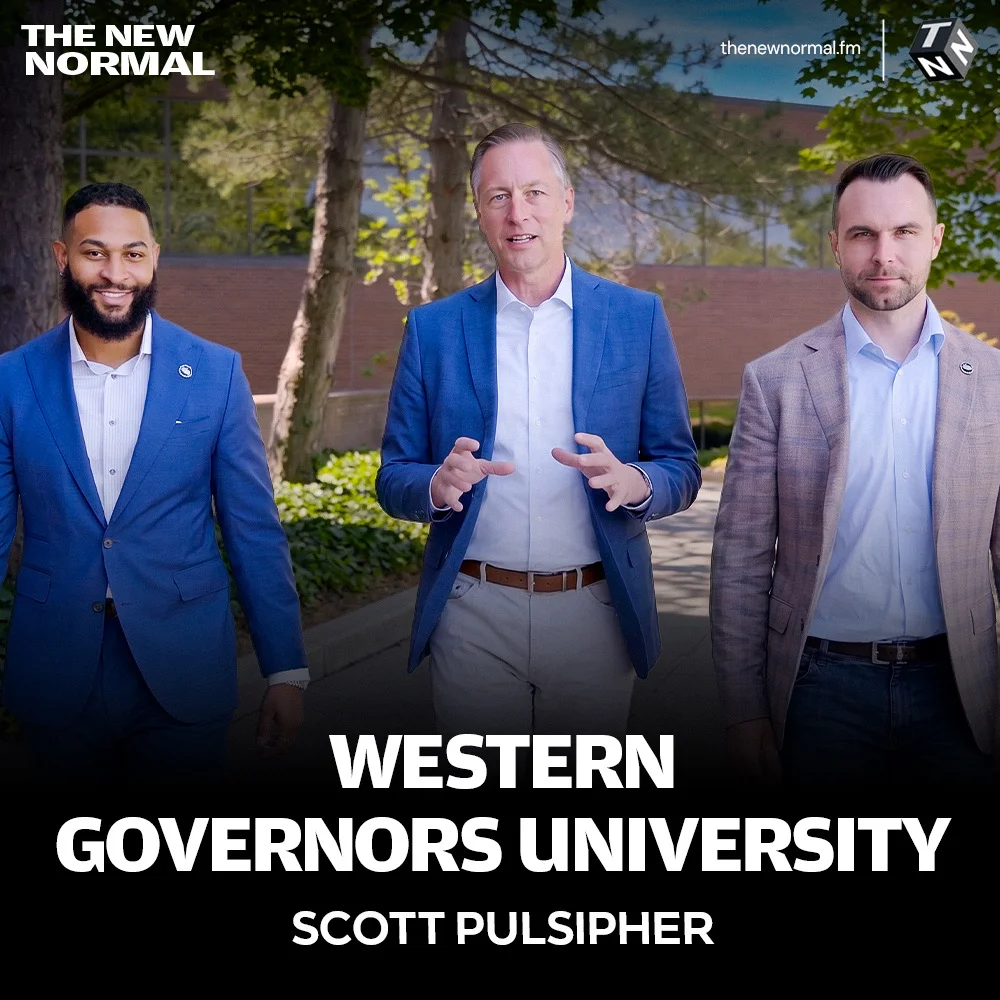










Scott Pulsipher is the President of Western Governors University, the largest online nonprofit university in the United States, serving more than 190,000 concurrently enrolled students across all 50 states. Unlike most university presidents, he did not come up through the academic ranks: he spent over 20 years building technology companies, led teams at Amazon, and grew one startup's revenue eightfold in under two years before joining higher education in 2016.
At WGU he has brought that operating experience to a competency-based, tech-first model built around what he calls student obsession. Under his leadership the university has grown from roughly 65,000 to nearly 200,000 concurrent students and passed half a million degrees awarded, while his team designs an AI-native successor to the model that got them there.
Western Governors University is the largest nonprofit online university in the United States, with nearly 200,000 students currently enrolled. Scott Pulsipher has been its president since 2016, and his background isn't what you'd expect: 20 years in tech and business, including a stint as general manager at Amazon, before taking the job at WGU.
Recorded at WGU headquarters in Salt Lake City, the conversation with OutRival co-founders Ruben Harris and Timur Meyster covers his Amazon-imported management principles and his framework for where AI belongs in higher ed — from matching the technology to the complexity of the task, to doubling a mentor's capacity with agents, to the “replication trap” that catches institutions moving programs online. Pulsipher's team is already building WGU 2.0, an AI-native successor to the model that produced their first half a million degrees.












.png)